
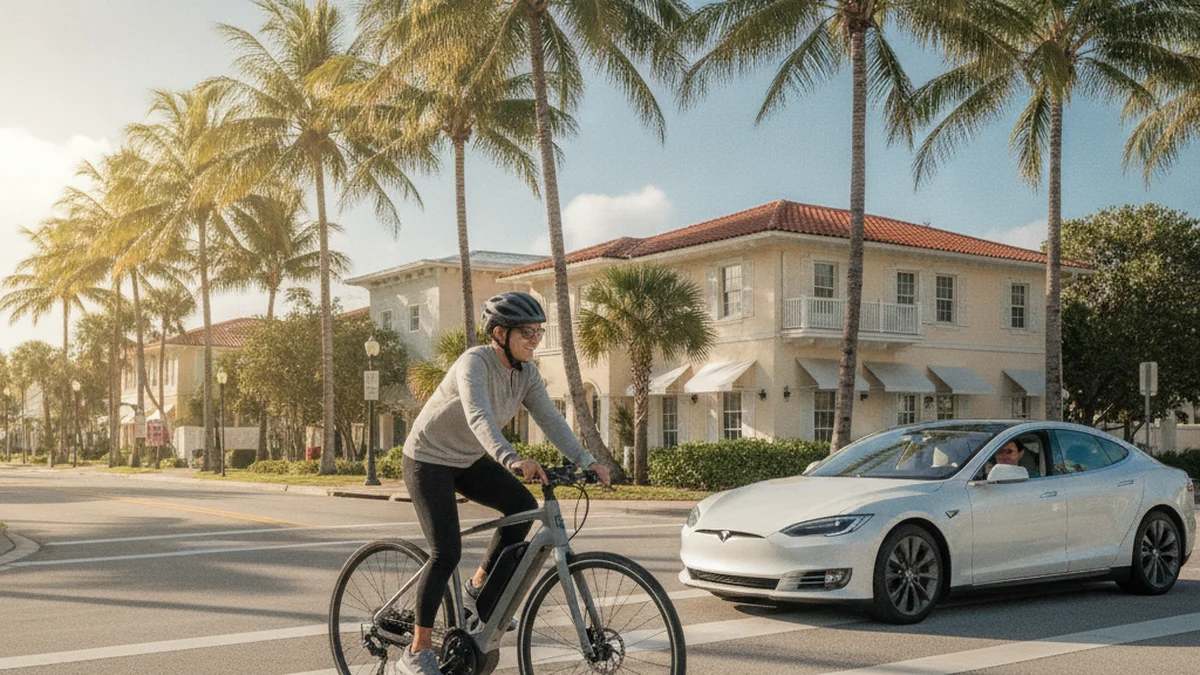
Most serious e-bike injuries in Florida do not happen on trails or bike paths—they happen in the road, when a motor vehicle and an electric bicycle occupy the same space at the wrong moment. Understanding who had the right of way, what the law required of each party, and how fault is allocated afterward can mean the difference between a full recovery and a sharply reduced one.
This article walks through the most common car-versus-e-bike crash patterns on Florida roads, explains the right-of-way rules that govern each scenario, and describes how comparative negligence affects what an injured rider may ultimately recover. For a broader overview of e-bike injury claims, see DiStefano Law’s e-bike accident practice page.
How Florida Law Treats E-Bike Riders on the Road
Florida’s electric bicycle statute, § 316.20655, Fla. Stat., establishes a foundational rule: an electric bicycle and its rider have the same rights and duties as a conventional bicycle and rider. This means an e-bike rider is entitled to use the roadway, is owed a duty of care by motorists, and is equally bound by Florida’s traffic laws.
The practical details flow from § 316.2065, Fla. Stat., Florida’s bicycle-specific regulations, which apply to e-bikes in full. Among other requirements, riders must use lights at night (a white front light visible from at least 500 feet and a red rear reflector or light), must ride in the direction of traffic, and must generally stay as far right as practicable on the roadway. Riders under 16 must wear a helmet. These are not suggestions—they are enforceable traffic rules, and a rider who violates one while also being struck by a careless driver may face a reduced recovery under Florida’s comparative fault statute.
Common Car-vs.-E-Bike Crash Patterns and Who Typically Has the Right of Way
The following crash types account for the large majority of serious e-bike injuries on Florida roads, including corridors such as Orlando’s Orange Blossom Trail (US-441), Fort Lauderdale’s US-1 (Federal Highway), and Fort Myers’ US-41.
- The right hook. A driver moving in the same direction as the rider makes a right turn across the bike lane or the edge of the travel lane, cutting off the cyclist. Because the rider is proceeding straight with the flow of traffic and the driver is making a turn, the driver is ordinarily at fault for failing to yield to the cyclist already in that portion of the roadway. This is one of the most common—and most injurious—collision types on busy urban corridors.
- Dooring. A parked motorist opens a vehicle door into an approaching rider’s path. The rider has no reasonable ability to stop in time. Florida traffic law prohibits opening a vehicle door into moving traffic, and liability typically falls on the person who opened the door. E-bike riders traveling at higher speeds than conventional cyclists may have even less margin to avoid a suddenly opened door.
- Left-turn-across-path (LTAP). A driver approaching from the opposite direction turns left across the path of an oncoming rider at an intersection. Drivers turning left must yield to oncoming traffic, which includes cyclists and e-bike riders. When a driver misjudges an e-bike’s speed—a common error, since e-bikes can travel at 20–28 mph depending on class under § 316.003(3), Fla. Stat.—the resulting collision is often severe.
- Failure to yield from a side street or driveway. A driver pulls out of a side street, parking lot, or driveway without yielding to a rider traveling on the main road. The rider on the through road has the right of way; the driver entering the roadway must stop and yield. E-bikes traveling silently at higher speeds can be difficult for drivers to detect in time, which is a recurring factor in these crashes along stretches such as Federal Highway in Fort Lauderdale.
How Fault Is Determined After a Collision
Fault in a car-versus-e-bike crash is determined by examining which party violated a rule of the road at the moment of impact—and to what degree each party’s conduct contributed to the outcome. Investigators, insurance adjusters, and attorneys look at physical evidence (skid marks, debris fields, vehicle damage), witness accounts, surveillance or dashcam footage, and the responding officer’s report.
A critical point: the fault notation in a police report is not a final legal determination. Officers assign fault based on what they observe at the scene, which may be incomplete. The officer may not have spoken to all witnesses, may not have reviewed available video, and is not conducting a full legal analysis of negligence. In litigation, the initial report is one piece of evidence among many—it is routinely challenged and refined as additional facts emerge. Riders who are told at the scene that the crash was their fault should not assume that assessment will control their claim. For more on navigating the aftermath of a crash, see what to do after an e-bike accident in Florida.
How Comparative Negligence Can Reduce a Rider’s Recovery
Florida follows a modified comparative negligence framework under § 768.81, Fla. Stat. (as amended by HB 837 in 2023). Under this rule, a plaintiff’s damages are reduced in proportion to their own percentage of fault—but if a court finds the plaintiff was more than 50% at fault for the crash, the plaintiff recovers nothing.
For e-bike riders, this creates a practical risk when the rider was also violating a rule of the road at the time of the crash. Common examples include:
- Wrong-way riding. A rider traveling against the direction of traffic who is struck by a turning driver may be found substantially at fault, because the driver reasonably expected no oncoming cyclist in that lane.
- Riding without required lights at night. If a crash occurs after dark and the rider had no front light or rear reflector as required by § 316.2065, an insurer or defense attorney will argue the rider’s lack of visibility contributed to the collision.
- Running a stop sign or red light. A rider who entered an intersection unlawfully bears a share of fault for any crash that results, regardless of how a driver behaved.
- Riding on a sidewalk in a prohibited area. Local ordinances in some Florida cities restrict sidewalk riding; a crash that occurs while a rider is violating such an ordinance can complicate the fault analysis.
Comparative fault determinations are contested by evidence, not simply conceded. Even if a rider made an error, the driver’s fault—inattention, excessive speed, failure to yield—may substantially outweigh it, allowing a meaningful recovery. For a fuller discussion of fault allocation in e-bike claims, see who is liable in a Florida e-bike accident.
Insurance Coverage After a Car-vs.-E-Bike Crash
Florida’s personal injury protection (PIP) system, governed by § 627.736, Fla. Stat., provides a baseline of $10,000 in medical and wage-loss benefits for those injured in motor vehicle crashes—but PIP attaches to motor-vehicle insurance policies. An e-bike rider who does not own or reside with someone who owns a motor vehicle may not have access to PIP coverage for their injuries.
Because of this coverage gap, the driver’s liability insurance typically becomes the primary source of compensation for a seriously injured rider. That may include coverage for medical expenses, lost income, and pain and suffering. One important deadline: Florida’s PIP statute requires that a crash victim seek initial medical treatment within 14 days of the injury to preserve PIP eligibility. Riders who delay treatment risk losing access to those benefits, in addition to weakening the overall injury claim.
Florida’s statute of limitations for negligence claims, including e-bike accident claims, is now two years from the date of injury under § 95.11, Fla. Stat. (changed from four years by HB 837, effective March 2023). Missing this deadline extinguishes the right to sue, regardless of how strong the case might otherwise be.
Why Injured Riders in Florida Turn to DiStefano Law
DiStefano Law LLC represents injured e-bike riders throughout Florida, from Fort Lauderdale and Broward County to the Orlando area, Fort Myers, and across the state. Robert DiStefano, Esq., founded the firm and has practiced Florida personal-injury law for more than 40 years. The firm has recovered more than $100 million for Florida accident victims. Robert personally handles the cases the firm accepts—clients work directly with the attorney managing their matter, not with a rotating cast of associates or an intake call center. The firm works on a contingency fee basis: there is no attorney’s fee unless the firm recovers compensation for you.
Frequently Asked Questions
If a driver hits me while I’m riding my e-bike, does the driver automatically owe me compensation?
Not automatically. Florida uses a fault-based system for claims above the PIP threshold. If the driver was negligent—by failing to yield, making an improper turn, or violating another traffic rule—that driver’s liability insurance is responsible for your damages. However, if you were also violating a traffic rule at the time, your recovery may be reduced under Florida’s comparative negligence statute (§ 768.81). The proportions are determined through investigation and, if necessary, litigation.
Does it matter that the police report says the crash was my fault?
The police report reflects the responding officer’s initial assessment at the scene, not a legal ruling. Officers often lack access to all witnesses, available video, or the full physical evidence at the time they write the report. In a civil claim, the report is one piece of evidence, and its fault attribution is routinely challenged when additional investigation reveals a different picture. An experienced attorney can help evaluate whether the report accurately reflects what happened.
What if I was riding at night without lights and a car hit me?
Florida law requires a front light and a rear reflector or light at night (§ 316.2065). Riding without required equipment is a traffic violation that can be used to argue you contributed to the crash. Under § 768.81, your recovery would be reduced by whatever percentage of fault a court assigns to you. If your share of fault is found to exceed 50%, you would recover nothing. That said, a driver who failed to look, who was speeding, or who turned without yielding still bears their own share of responsibility—the comparative analysis is not all-or-nothing.
How soon do I need to act after an e-bike crash involving a car?
Florida’s statute of limitations for negligence claims is two years from the date of injury (§ 95.11, Fla. Stat.). If you have access to a motor vehicle policy that includes PIP coverage, you must seek medical treatment within 14 days of the crash to preserve PIP benefits (§ 627.736). Beyond these deadlines, early legal consultation matters because evidence—surveillance footage, witness contact information, vehicle event data—can disappear quickly after a crash.
If you or someone you know was injured in a car-versus-e-bike collision anywhere in Florida, DiStefano Law LLC offers a free, confidential, same-day case review (Monday through Friday). Call (954) 572-8000 or visit the contact page to get started. There is no fee unless we recover for you.