
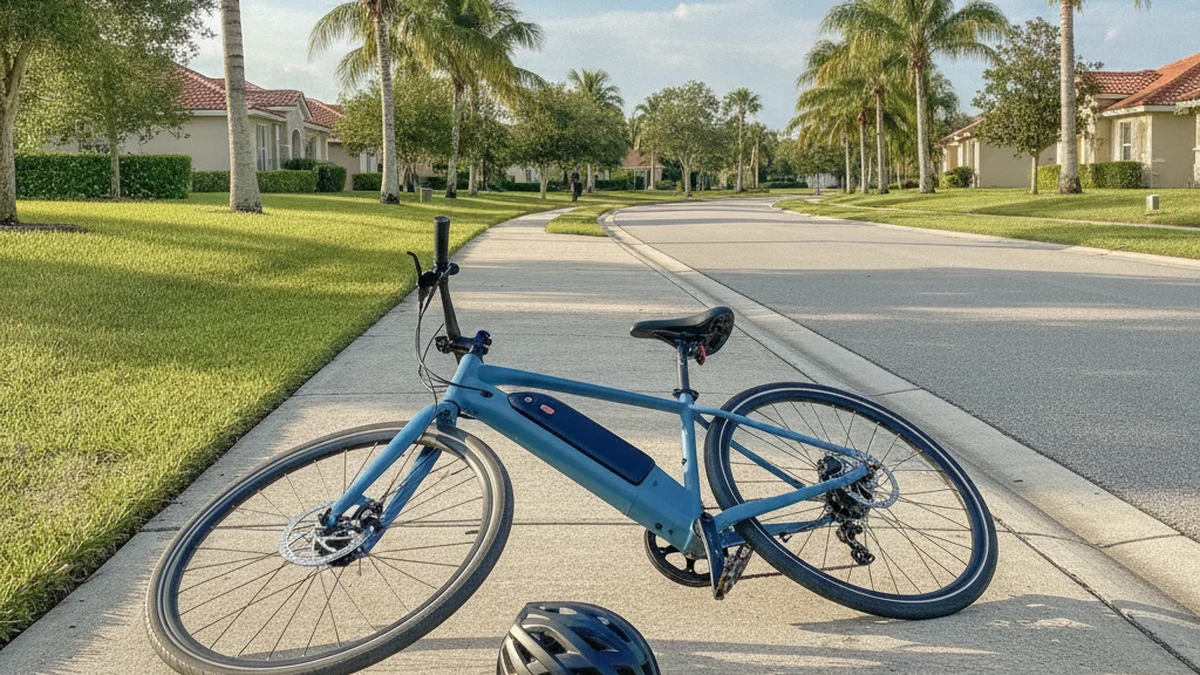
E-bike use has expanded rapidly across Florida, from Fort Lauderdale’s A1A beach corridor to the downtown River District of Fort Myers. With that growth has come a rise in e-bike crashes, many of them serious. The decisions you make in the first minutes—and the first days—after a crash can significantly affect your health and your legal options. This guide walks through the steps injured riders and their families should take, from the scene through the point of consulting an attorney.
Step 1: Get to Safety and Call 911
The first priority after any crash is physical safety. If you can move without aggravating your injuries, get yourself and your e-bike out of the roadway or bike lane. Remaining in active traffic increases the risk of a secondary collision, which is a serious danger on high-volume corridors such as A1A in Fort Lauderdale or McGregor Boulevard in Fort Myers.
Call 911 immediately, even if the crash seems minor at the moment. A police report creates an official contemporaneous record of where the crash occurred, who was involved, what each party said, and what conditions existed at the scene. Without a report, it becomes a he-said-she-said dispute that is far harder to resolve. When the officer arrives, give an accurate account of what happened and ask for the report number before they leave.
Step 2: Document the Scene Thoroughly
If your injuries permit, use your phone to document the scene before anything is moved or cleaned up. Useful photographs and notes include:
- The position of the e-bike, any motor vehicle involved, and any debris on the road
- Skid marks, broken glass, and road-surface conditions (potholes, paint markings, gravel)
- Traffic signals, stop signs, or bike-lane markings visible from the point of impact
- The e-bike itself—frame damage, wheel damage, the motor, and especially the battery unit
- Your helmet, clothing, and any protective gear (document before removing)
- Visible injuries to yourself or others
- The license plates, make, model, and color of any vehicles involved
- Names and contact information for witnesses
Document the e-bike’s brand, model, and serial number if you can locate it. If the crash involved a mechanical failure—sudden brake loss, unexpected acceleration, or a battery issue—that documentation may become critical for a product-liability claim. Our article on e-bike battery fires and product liability in Florida explains how defective-product claims work in that context.
Step 3: Seek Medical Care Promptly—The 14-Day Rule Matters
Even if you feel well at the scene, see a physician or go to an emergency room as soon as possible—and no later than 14 days after the crash. That deadline matters under Florida law. Under § 627.736, Fla. Stat., personal injury protection (PIP) benefits—up to $10,000 in baseline medical and lost-income coverage—are only available if the injured person receives initial treatment within that 14-day window. Miss the window and the coverage may be forfeited entirely.
PIP was designed for motor-vehicle occupants, so whether it extends to an e-bike rider depends on the policies in place; a Florida attorney can review your specific situation. Beyond insurance, prompt treatment protects your health and prevents insurers from arguing that your injuries were not caused by the crash.
Step 4: Exchange Information and Avoid Admitting Fault
Exchange the following information with every other party involved in the crash: full legal name, address, phone number, driver’s license number, vehicle registration, and insurance company and policy number. If a commercial vehicle was involved—a delivery van, rideshare vehicle, or rental car—also record the company name and any visible fleet or unit numbers.
Be careful about what you say at the scene. Florida follows a modified comparative negligence rule under § 768.81, Fla. Stat. (as amended by HB 837 in 2023): if a court finds you more than 50 percent at fault for the crash, you recover nothing. If you are found partially at fault below that threshold, your recovery is reduced by your percentage of fault. Statements like “I should have been watching more carefully” or “I didn’t see the light” can be used against you later to assign a higher share of fault. Stick to factual descriptions of what happened and let the evidence speak.
Step 5: Preserve the E-Bike and Its Battery as Physical Evidence
Do not repair, discard, or allow anyone else to inspect or test the e-bike without first speaking to an attorney. The e-bike itself—including its battery, motor controller, throttle mechanism, and braking system—may be the most important piece of physical evidence in your case, particularly if a product defect contributed to the crash or the severity of your injuries.
Store the e-bike and any detached components in a secure, dry location. If the battery was damaged, handle it carefully—a damaged lithium-ion cell can pose a fire risk—and keep it away from flammable materials. Note the battery’s age, charge level at the time of the crash, and the manufacturer. For a deeper look at how defective e-bike components affect liability, see our guide to e-bike accident claims in Florida.
Step 6: Be Careful With Social Media and Recorded Statements
In the days following the crash, resist the impulse to post about the accident, your injuries, or your recovery on any social media platform. Insurance adjusters and defense attorneys routinely monitor claimants’ public accounts. A photograph of you appearing active, or a comment minimizing your injuries, can be taken out of context and used to dispute the seriousness of your claim.
You are also not required to give a recorded statement to the other party’s insurance company before speaking with your own attorney. Adjusters may frame such a request as a routine formality, but the questions are designed to elicit information that can reduce or deny your claim. Politely decline until you have spoken with counsel.
Step 7: Consult an Attorney—and Be Aware of Florida’s Two-Year Filing Deadline
Under § 95.11, Fla. Stat. (as amended by HB 837 in 2023), most personal-injury negligence claims in Florida—including e-bike accidents—must be filed within two years of the date of injury, down from the prior four-year period. Evidence degrades and witnesses become unavailable, so acting promptly protects your options. An attorney can evaluate driver fault, road-design or maintenance issues, product-liability exposure, and how Florida’s comparative fault rules affect your recovery. For an overview of claim values, see our article on what an e-bike accident claim is worth in Florida.
Why Injured Riders in Florida Turn to DiStefano Law
DiStefano Law LLC is a Fort Lauderdale personal-injury firm that handles e-bike accident claims throughout the state of Florida, including in Broward County, Lee County, and the surrounding communities. Robert DiStefano, Esq., the firm’s founder and managing attorney, has more than 40 years of Florida personal-injury practice and has recovered over $100 million for injured Florida clients. He personally handles the cases his firm accepts—there is no intake call center and no rotating associates.
The initial case review is free, confidential, and available the same day you call (Monday through Friday). Because the firm works on a contingency-fee basis, there is no attorney’s fee unless the firm recovers compensation for you.
Frequently asked questions
Do I need a police report after an e-bike accident in Florida?
Florida law requires a crash report when a traffic accident results in injury, death, or property damage above a certain threshold. Even when a report is not technically required, filing one creates an official contemporaneous record that supports your injury claim. Always call 911 after an e-bike crash that involves another vehicle or results in injury.
What is the 14-day rule for PIP after an e-bike accident?
Under § 627.736, Fla. Stat., personal injury protection (PIP) benefits are only available if the injured person receives initial medical treatment within 14 days of the accident. Waiting longer than 14 days may bar access to PIP coverage. Whether PIP applies to an e-bike rider depends on the specifics of the insurance policies involved, which an attorney can review.
How long do I have to file a lawsuit after an e-bike accident in Florida?
Under § 95.11, Fla. Stat., most personal-injury negligence claims in Florida—including e-bike accident claims—must be filed within two years of the date of injury. This deadline was shortened from four years by HB 837, enacted in March 2023. Missing the deadline typically bars the claim entirely, which is one reason prompt legal consultation is important.
Should I give a recorded statement to the insurance company after my e-bike accident?
You are not obligated to give a recorded statement to the opposing party’s insurance company before consulting an attorney. These statements are often used to gather information that can reduce or deny a claim. You should speak with a Florida personal-injury attorney before agreeing to any recorded statement following a serious e-bike accident.
If you or a family member was injured in an e-bike accident in Florida, DiStefano Law offers a free, confidential, same-day case review. Reach Robert DiStefano directly at (954) 572-8000 or through the firm’s contact page. There is no fee unless we recover for you.