
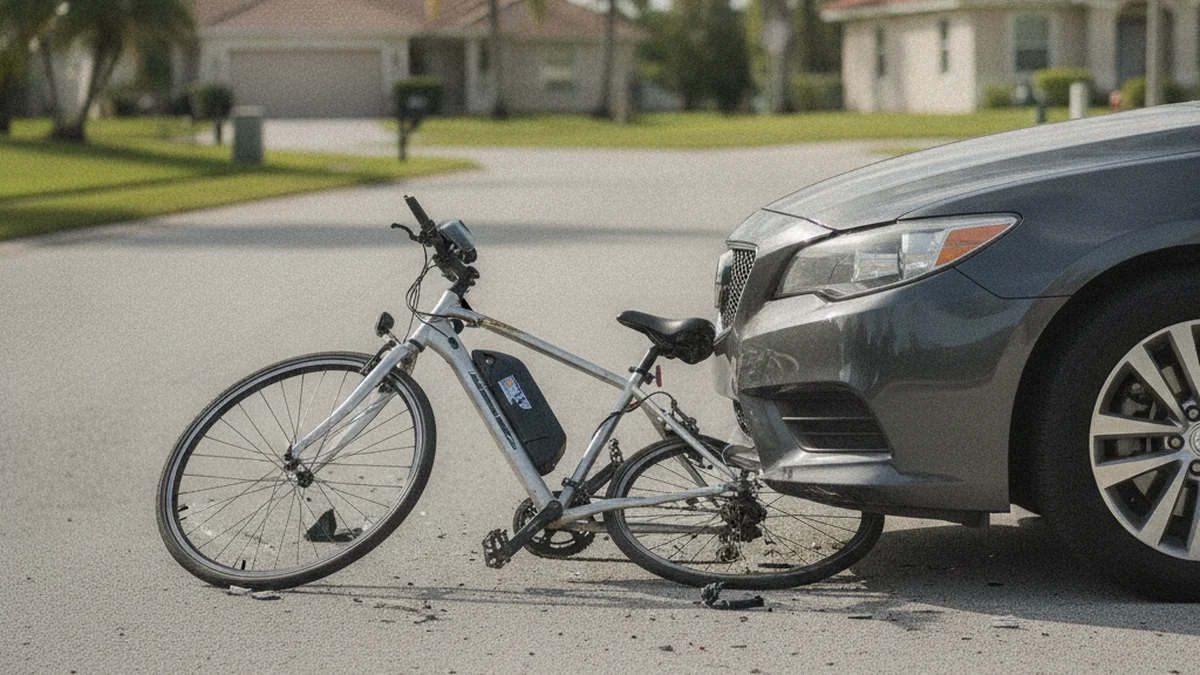
E-bike use has risen sharply across Florida, and so have the injuries that follow. When a rider is hurt—or a pedestrian or motorist is hurt by an e-bike—the question of legal responsibility is rarely simple. Florida law allows injured parties to pursue claims against multiple defendants, and identifying each potentially liable party is the first step toward a full recovery.
This article covers the most common defendants in Florida e-bike accident cases, what a claimant must prove, and how Florida’s comparative-negligence rule can reduce or bar recovery. Anyone injured in an e-bike crash should consult a Florida personal-injury attorney about their specific situation.
Parties who may be liable in a Florida e-bike accident
Florida law recognizes that multiple parties can share responsibility for a single accident. An injured rider or victim may have valid claims against one or several of the following:
- A negligent motorist. Drivers who fail to yield, cut off a cyclist, or open a door into a travel lane are among the most common defendants in Florida e-bike accident cases. Under § 316.20655, Fla. Stat., an e-bike and its rider carry the same rights and duties as a conventional bicycle, so a driver liable for hitting a bicycle is equally liable for hitting an e-bike. Intersections along Fort Lauderdale’s A1A corridor and Las Olas Boulevard are among the Broward County locations where these conflicts arise.
- An e-bike or battery manufacturer. A defective throttle, faulty motor controller, or battery failure may support a product-liability claim against the manufacturer or distributor, entirely separate from any negligence theory. Battery-related failures are addressed at e-bike battery fires and product liability in Florida.
- A property owner or path maintainer. Private owners and homeowners associations that maintain paths, parking lots, or private roads must keep those surfaces reasonably safe. A pothole, unmarked drop-off, or debris on a shared-use path can support a premises-liability claim.
- A government entity. State, county, and municipal governments must maintain public roads and shared-use paths in reasonably safe condition. Orlando’s International Drive and downtown corridors—which handle heavy mixed traffic—illustrate where a missing sign, broken curb cut, or hazardous expansion joint can ground a claim. Government claims carry specific notice requirements and sovereign-immunity limits that make early legal consultation especially important.
How liability is proven: duty, breach, causation, and damages
Regardless of the defendant, a personal-injury claim in Florida requires proof of four elements:
- Duty. The defendant owed the injured person a legal duty of care—motorists to all road users, manufacturers to produce safe products, property owners to maintain safe conditions for lawful visitors.
- Breach. The defendant failed to meet that duty: running a red light, shipping a defective battery, leaving a hazard on a path, or failing to repair a known road defect.
- Causation. The breach caused the injury. This is frequently the most contested element; defendants often argue the rider’s own conduct—excessive speed or riding without lights as required by § 316.2065, Fla. Stat.—was the real cause.
- Damages. The plaintiff suffered actual, compensable harm: medical expenses, lost wages, pain and suffering, and related losses.
Product-liability claims may rely on strict-liability or breach-of-warranty theories, neither of which requires proof of subjective carelessness, but causation and damages must still be shown.
Florida’s modified comparative-negligence rule
Under § 768.81, Fla. Stat. (HB 837, effective March 2023), Florida uses a modified comparative-negligence system: a plaintiff 50% or less at fault recovers damages reduced by their percentage of fault; a plaintiff found more than 50% at fault recovers nothing at all.
Defense attorneys frequently argue that riders contributed to their own injuries—by using a lane not permitted for the e-bike’s class under § 316.003(3), Fla. Stat., by riding without adequate lighting, or by traveling faster than surrounding traffic could anticipate. The helmet requirement under § 316.2065 applies only to riders under 16, so its absence does not automatically increase an adult rider’s share of fault, but other conduct choices can still sharply reduce or eliminate a recovery. How these fault-allocation arguments play out in practice is closely tied to the right-of-way rules covered at e-bike and car accidents: right of way in Florida. The strength of the liability case against other parties is therefore directly linked to how the victim’s own conduct is characterized.
Insurance coverage and multiple defendants
E-bike accident cases often involve more than one insurance source. Florida’s personal injury protection (PIP) benefit under § 627.736, Fla. Stat. provides up to $10,000 in coverage for injuries arising from the use of a motor vehicle, and it attaches to motor-vehicle policies; when a car strikes a rider, PIP may be accessible through the at-fault driver’s policy or a household auto policy. The 14-day treatment deadline under the same statute means injured riders must seek medical attention promptly to preserve PIP eligibility. Riders should also review any uninsured/underinsured motorist coverage on a household auto policy—this coverage often travels with the insured even when they are outside a vehicle. When a product defect and a road hazard both play a role, product-liability and government-entity claims may run alongside a negligence claim, and Florida courts apportion fault among all responsible parties.
The statute of limitations
Under § 95.11, Fla. Stat. (as amended March 2023), most negligence claims must be filed within two years of the date of injury. Claims against government entities carry additional procedural notice requirements with shorter deadlines. Consulting an attorney promptly after an e-bike accident is the most reliable way to ensure all claims are preserved.
Why DiStefano Law for an e-bike liability case
DiStefano Law LLC has practiced Florida personal-injury law for more than 40 years and has recovered over $100 million for accident victims across the state. Robert DiStefano, Esq., the firm’s founder and managing attorney, personally handles every accepted case—no intake call centers, no rotating associates. The firm serves clients statewide, from Broward County to Orlando, handling most work by phone, email, and video. The initial case review is free, confidential, and same-day. More on how e-bike claims are evaluated is on the firm’s Florida e-bike accident practice page.
Frequently asked questions
Can I sue the driver who hit me if I was partly at fault?
Yes, if you were 50% or less at fault. Under § 768.81, Fla. Stat., your recovery is reduced by your own percentage of fault, but is not eliminated unless a court finds you more than 50% responsible.
What if the e-bike itself malfunctioned and caused the accident?
A defect in the motor, throttle, braking system, or battery may support a product-liability claim against the manufacturer or distributor, separate from any negligence claim. Preserving the e-bike as evidence is critical.
Does Florida PIP cover e-bike accident injuries?
Florida’s personal injury protection (PIP) benefit under § 627.736, Fla. Stat. attaches to motor-vehicle policies. When a car strikes a rider, PIP may be available through the at-fault driver’s policy or a household auto policy. An attorney can identify every available coverage source.
How long do I have to file a Florida e-bike accident claim?
Most negligence claims must be filed within two years of the injury (§ 95.11, Fla. Stat., as amended March 2023). Claims against government entities carry additional notice deadlines. Missing a deadline typically bars recovery permanently.
To discuss a Florida e-bike accident with Robert DiStefano directly, call (954) 572-8000 or visit the contact page to request a free, confidential, same-day case review. There is no fee unless we recover for you.