
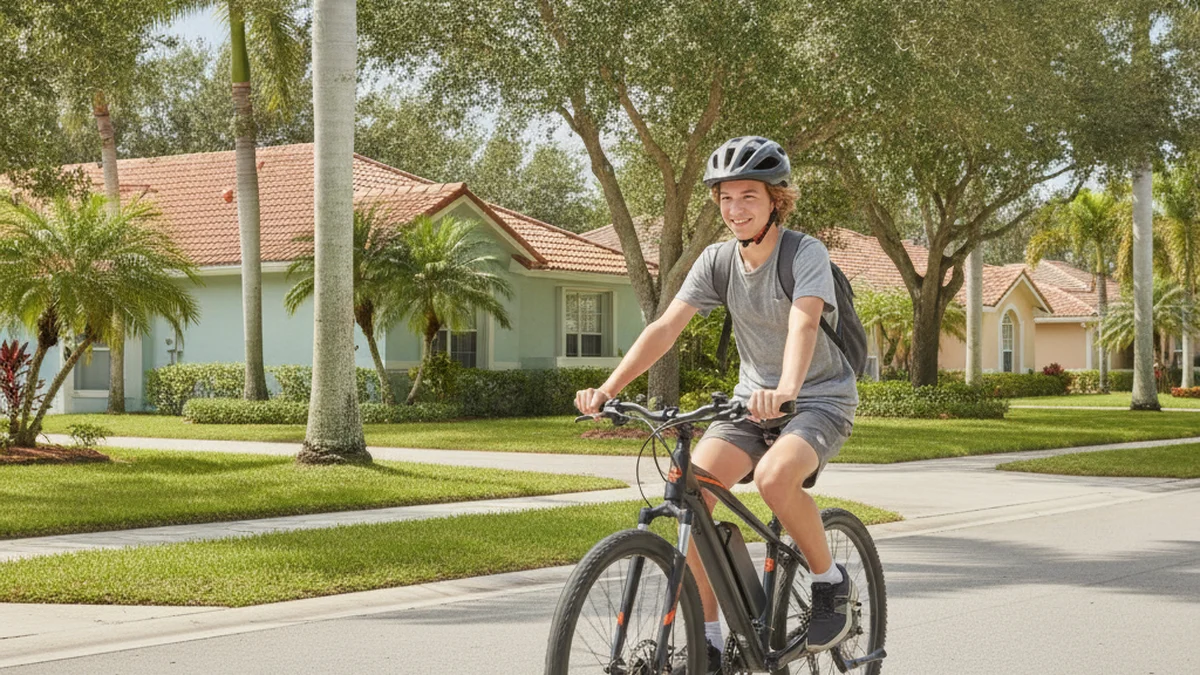
Electric bicycles have become a common sight in suburban Florida neighborhoods, from the planned communities around Naples and Sarasota to the residential streets of Broward County. Teenagers and preteens ride them to school, to friends’ homes, and around community paths — often without adults fully understanding what Florida law requires or what dangers a high-speed e-bike poses for young riders. For parents, understanding the rules is not merely practical; it may determine whether a family bears significant financial and legal consequences after a crash.
Florida’s Three-Class E-Bike System
Under § 316.003(3), Fla. Stat., Florida divides e-bikes into three classes:
- Class 1: Pedal-assist only; the motor stops assisting when the rider reaches 20 mph.
- Class 2: Throttle-capable (no pedaling required); motor stops at 20 mph.
- Class 3: Pedal-assist only, but the motor continues assisting up to 28 mph.
The distinction matters for young riders. A Class 3 e-bike can reach speeds that exceed what many child cyclists can control safely, and a Class 2 throttle model lets a younger child accelerate to 20 mph with minimal physical effort. Under § 316.20655, Fla. Stat., an e-bike and its rider have the same rights and duties as a conventional bicycle and rider. An e-bike may be ridden wherever bicycles are permitted, subject to limited local exceptions for Class 3 bikes on certain shared-use paths — and the full range of Florida’s bicycle regulations applies, including to minors.
The Helmet Requirement and What State Law Actually Says About Age
§ 316.2065, Fla. Stat. governs bicycle regulations in Florida and, because e-bikes are treated as bicycles, those rules extend to e-bike riders. The statute requires every rider under the age of 16 to wear a properly fitted and fastened helmet while riding on any public road, bicycle path, or publicly accessible area. This is the clearest, most uniform statewide rule for young e-bike riders — it applies regardless of which class of e-bike the child is using.
Florida does not impose a single, blanket minimum age to operate every class of e-bike statewide. The clearest statewide rule tied specifically to age is the under-16 helmet requirement. Local governments and homeowners’ associations in communities throughout Broward County, Naples, and Sarasota frequently adopt their own ordinances that may set age restrictions, limit where certain classes of e-bikes may be ridden, or require additional safety equipment. Before allowing a minor to ride, parents should verify what rules apply in their specific municipality or planned community — checking with the local parks department or reviewing community association rules is a practical first step.
Speed and Safety Risks for Young Riders
Speeds that seem modest by adult standards can present serious hazards for young cyclists. A child unfamiliar with riding at 20–28 mph faces longer stopping distances, tighter reaction-time windows, and less margin for road hazards — an opening car door, a wet section of a Sarasota community path, a crossing pedestrian on a Broward neighborhood street. E-bike use and e-bike injuries have risen sharply in recent years, and a meaningful share of those incidents involve younger riders. For families considering an e-bike for a teenager, matching the bike class to the rider’s age and experience, requiring helmets, and setting geographic limits are practical starting points.
Parental Responsibility
Florida does not have a statute that automatically makes a parent liable every time a minor causes an injury with an e-bike. Liability is typically assessed based on whether a parent exercised reasonable care in supervising the child and in entrusting the child with the vehicle. A parent who places a Class 3 e-bike in the hands of a young child with no instruction, no helmet, and no familiarity with local traffic conditions has likely not met a reasonable standard of supervision.
Parents should also review their homeowners’ or umbrella insurance policies with their agent — coverage for a minor child who injures another person while riding an e-bike may vary significantly depending on the policy. Understanding coverage before an incident occurs is far better than discovering gaps afterward.
When a Child Is Injured by a Negligent Driver
When a minor riding an e-bike is struck by a motor vehicle through the driver’s fault, a personal-injury claim may be available. Florida’s personal injury protection (PIP) system under § 627.736, Fla. Stat. provides a baseline $10,000 in benefits, but PIP attaches to motor-vehicle insurance policies. A child injured while riding an e-bike may be able to access PIP coverage under a parent’s auto policy — but coverage depends on the specific policy language, and the injured party must seek medical treatment within 14 days of the accident to preserve PIP eligibility.
Beyond PIP, a negligence claim against the at-fault driver may recover damages not covered by PIP, including pain and suffering, future medical care, and long-term rehabilitation costs. Children injured in serious e-bike crashes — on a Broward County suburban road, on a Naples community path, or along a Sarasota corridor — may face months or years of recovery. The firm’s Florida e-bike accident guide provides a detailed overview of how these cases are evaluated, and the what to do after an e-bike accident article covers immediate steps a family should take at the scene.
Comparative Negligence When a Minor Is Partly at Fault
Florida’s modified comparative negligence rule under § 768.81, Fla. Stat. — amended by HB 837 in 2023 — states that a plaintiff found more than 50% at fault recovers nothing. A plaintiff found partially at fault but not more than 50% has their recovery reduced by their percentage of fault. When the injured party is a child, courts and juries consider what level of care is reasonable for a child of that age and experience — a young child is not held to the same standard as an adult.
The details of how an accident happened matter: whether the child had lights (required under § 316.2065, Fla. Stat. when riding at night), whether a helmet was worn, the child’s speed, and the driver’s conduct all bear on the outcome. Most negligence claims must be filed within two years of the injury under § 95.11, Fla. Stat. (as changed by HB 837, March 2023). Delaying evaluation of a potential claim risks losing the right to pursue it. For a fuller discussion of liability in e-bike accidents, the firm’s e-bike accident practice page covers the key issues.
About DiStefano Law
DiStefano Law LLC, based in Fort Lauderdale, has represented injured Floridians for more than 40 years and has recovered over $100 million for accident victims across the state — including e-bike cases involving minor riders in Broward County communities and the planned neighborhoods of Naples and Sarasota. Robert DiStefano, Esq. personally handles every matter the firm accepts. A free, confidential, same-day case review is available Monday through Friday.
Frequently asked questions
Does Florida require children to wear a helmet while riding an e-bike?
Yes. Under § 316.2065, Fla. Stat., every rider under 16 must wear a properly fitted and fastened helmet on any public road, bicycle path, or publicly accessible area. Because Florida treats e-bikes as bicycles under § 316.20655, this applies to e-bike riders as well. Riding without a helmet is a statutory violation and may affect an injury claim if a head injury results.
Is there a minimum age to ride an e-bike in Florida?
Florida does not impose a single blanket minimum age to operate every class of e-bike statewide. The clearest statewide age rule is the under-16 helmet requirement. Local governments and community associations in areas such as Broward County, Naples, and Sarasota may impose their own age restrictions or limit where certain classes may be ridden. Parents should check local ordinances and community rules before allowing a minor to ride.
Can a child injured on an e-bike recover compensation even if they were partly at fault?
Potentially yes. Under § 768.81, Fla. Stat., a person who is 50% or less at fault may recover compensation, reduced by their percentage of fault. For minor riders, courts consider what behavior is reasonable for a child of that age. A rider found more than 50% at fault recovers nothing. An attorney can review the specific facts and explain how they affect a claim.
What should a parent do immediately after a child is hurt in an e-bike accident?
Seek emergency medical care first — adrenaline can mask serious injury, and prompt treatment preserves PIP eligibility, which requires care within 14 days. Document the scene, photograph the vehicles and location, and collect the driver’s insurance information. Contact a personal-injury attorney promptly; under § 95.11, Fla. Stat., most negligence claims must be filed within two years of the injury.
If your child was injured in an e-bike accident — or if you have questions about your family’s legal exposure as a result of a minor riding an e-bike — DiStefano Law LLC offers a free, confidential, same-day case review. Call (954) 572-8000 or visit the contact page to reach Robert DiStefano directly. There is no fee unless we recover for you.