
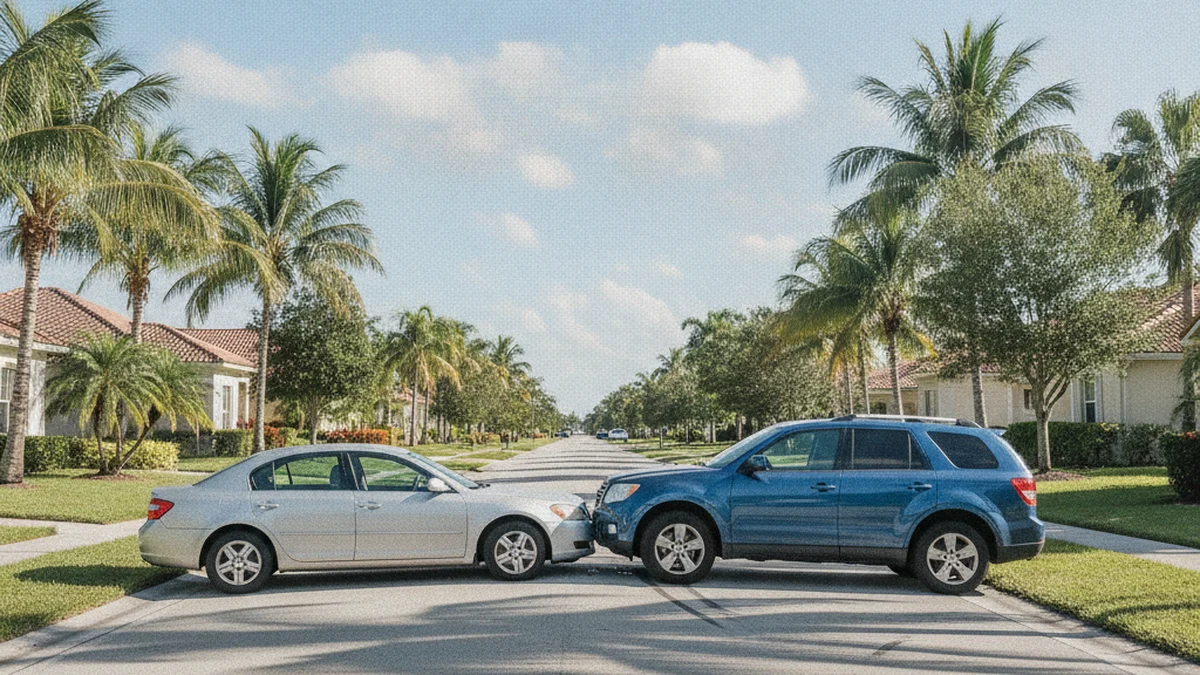
Here is something most Florida drivers don’t find out until it’s too late: the state does not make you carry insurance that pays for your injuries when the other driver is at fault. So when an uninsured driver hits you — and on South Florida roads that happens a lot — you can be left holding the bill for your own broken bones. The coverage that fills that gap is called uninsured and underinsured motorist coverage, and for many people it is the single most important line on their auto policy.
What uninsured and underinsured motorist coverage actually does
Uninsured/underinsured motorist coverage — usually shortened to UM/UIM — is coverage you buy on your own policy that steps in when the driver who hurt you can’t cover the damage. It comes in two flavors that work together:
- Uninsured motorist (UM) pays your injury costs when the at-fault driver has no liability insurance at all.
- Underinsured motorist (UIM) pays the difference when the at-fault driver has some coverage, but not enough to cover what they did to you. If a driver carries the bare-minimum policy and puts you in the hospital for two weeks, that minimum runs out fast — UIM picks up where their coverage stops.
It pays for your bodily injury — medical bills, lost wages, and pain and suffering — not the dent in the other person’s car. And unlike Florida’s no-fault system, it is not capped at a small benefit. Florida’s Personal Injury Protection (PIP), required under Florida Statute section 627.736, only pays up to $10,000 no matter who was at fault. UM/UIM is what you turn to when your injuries blow past that and the at-fault driver has nothing to give.
Why this matters so much in Broward County
Florida consistently ranks among the worst states in the country for uninsured drivers — estimates put the share of motorists with no insurance at roughly one in five. Add in everyone carrying only a minimum policy, and the odds that the person who hits you can actually pay for what they did are not good. That risk sits on the roads you drive every day: I-95, the Florida Turnpike, Oakland Park Boulevard, and the daily crush through Fort Lauderdale and the rest of Broward County. You can be the safest driver out there and still get hit by someone who has nothing. UM/UIM is the one part of your policy that protects you from other people’s bad decisions.
It even covers hit-and-run crashes — a part of UM coverage a lot of people don’t realize they’re paying for. If a driver clips you and speeds off and is never identified, there is no at-fault insurance company to pursue, so your own uninsured motorist coverage treats that phantom driver as an uninsured driver and pays your claim. That makes UM coverage especially valuable for riders, because Florida’s PIP does not cover motorcycle riders at all. One catch: insurers want prompt proof you reported the crash, so if you’re ever the victim of a hit-and-run, call law enforcement from the scene and get a report number. That report is often what makes the UM claim work later.
How “stacking” can multiply your coverage
If you own more than one vehicle, Florida lets you do something that can dramatically increase your protection. It’s called stacking, and it means combining the uninsured motorist limits across your vehicles into one larger pool of coverage.
Say you carry $50,000 in UM coverage on each of three cars. With stacked coverage, you may be able to add those limits together — giving you up to $150,000 to draw on after a single crash, no matter which of your cars you were driving. Without stacking, you’d be limited to the $50,000 on the one vehicle involved.
Stacking is one of the few places in insurance where the math works in your favor — more vehicles can mean more protection from the same coverage you already chose, often for a modest amount more in premium.
Florida lets you choose stacked or non-stacked coverage, and the price difference is usually small compared to how much extra protection you get. When you review your policy, this is a question worth asking your agent directly: am I stacked, and what would it cost to be?
Why your own insurance company still fights you
This is the part that surprises people the most, so I want to be blunt about it. When you make a UM/UIM claim, you are not dealing with the other driver’s insurance company — you are dealing with your own. And your own insurer does not simply hand over the money because you’ve paid your premiums for years.
A UM/UIM claim is, in practice, a claim against your insurance company, and they treat it like any other claim they’d rather pay less on. The same tactics show up:
- They question whether your injuries are really as serious as you say, or argue they came from something other than the crash.
- They ask for a recorded statement early, hoping you’ll say something they can use to shrink the claim.
- They lean on Florida’s shared-fault rule. Under Florida Statute section 768.81, as amended in 2023, your recovery is reduced by your percentage of fault — and if you’re found more than 50% at fault, you collect nothing. Your own carrier has every reason to argue your share of blame was high.
- They make a fast, low offer and count on you accepting it before you understand the full cost of your injury.
None of this means your insurer is the enemy. It means a UM/UIM claim is a negotiation, and the company on the other side of the table is one that does this for a living. Having a lawyer who handles these claims levels that table — and because Florida personal-injury cases run on a contingency fee, it costs you nothing up front to have someone in your corner against your own carrier.
Go check your declarations page
The single most useful thing you can do today is pull out your auto policy and look at your declarations page — the one- or two-page summary, often the first page of your policy, that lists your coverages and limits. Look for a line that says “uninsured motorist” or “UM/UIM.” Then ask yourself two things:
- Do I have it at all? Because Florida doesn’t require it, some drivers rejected it — sometimes without realizing what they were giving up. If there’s no UM line, you don’t have this protection.
- Are my limits high enough? A serious injury can run well past a small limit. Many people carry far less UM coverage than they’d want if they were the one in the hospital bed.
If you’ve turned it down or carry only a token amount, call your agent and ask what it would cost to add real coverage, and whether stacking makes sense for your household. It is usually one of the most affordable lines on the whole policy — and the one most likely to actually protect you and your family.
If you’ve already been hit by an uninsured driver
If a crash has already happened and the at-fault driver was uninsured, underinsured, or fled the scene, your UM/UIM coverage may be your main path to a real recovery — but getting your own insurer to pay it fairly is rarely simple. At DiStefano Law, we handle these claims the same way we handle every crash and collision case: we move fast to document the injuries, deal with the insurance company so you don’t have to, and push back hard when a carrier tries to lowball a claim you paid for. Whether it’s a straightforward fender-bender that turned serious or a complicated car accident with disputed fault, the goal is the same — the full value of your claim. Robert DiStefano has been doing this work in Broward County courts for more than 40 years.
If an uninsured or underinsured driver hurt you, or your own insurance company isn’t treating your claim fairly, don’t sort it out alone. Call DiStefano Law at (954) 572-8000 for a free, confidential, same-day case review, or reach out through our contact page. There is no fee unless we recover for you — and a quick look at your policy now could be the most important thing you do before you ever need it.
Frequently asked questions
What is uninsured/underinsured motorist coverage?
It’s optional coverage on your own auto policy that pays for your injuries when the at-fault driver has no insurance or not enough to cover your damages. In Florida, where many drivers are underinsured, it’s often the most valuable coverage you own.
Is UM/UIM coverage required in Florida?
No. Florida does not require it, and insurers must offer it but you can reject it in writing. Many drivers don’t realize they declined it until after a serious crash, which is why it’s worth checking your policy now.
Will my rates go up if I use my UM coverage?
You paid premiums for this coverage precisely so it would be there after a crash that wasn’t your fault. An insurer cannot fairly penalize you for using coverage you bought, and a UM claim is made against your own policy.
Learn more about how we handle these cases on our motor vehicle accidents page.