

When you are injured in an Uber or Lyft crash in Florida, the insurance that covers your medical bills depends on what the driver was doing at the exact moment of the collision. Florida law divides rideshare trips into three distinct coverage periods, each with different liability limits. Understanding which period applies to your crash determines where your claim begins — and how much coverage is available to you.
- Florida divides rideshare trips into three coverage periods; the applicable period controls which insurance policy responds first.
- Florida’s Personal Injury Protection (PIP) law still applies to rideshare crashes, but its $10,000 limit is frequently exhausted by serious injuries.
- Florida requires at least $1,000,000 in primary liability coverage from the moment a driver accepts a ride until the trip ends.
- Accepting a quick settlement before your medical treatment is complete can permanently limit your recovery.
- A rideshare accident attorney in Broward County can identify all available insurance layers before you speak with any adjuster.
How Florida Law Structures Rideshare Coverage
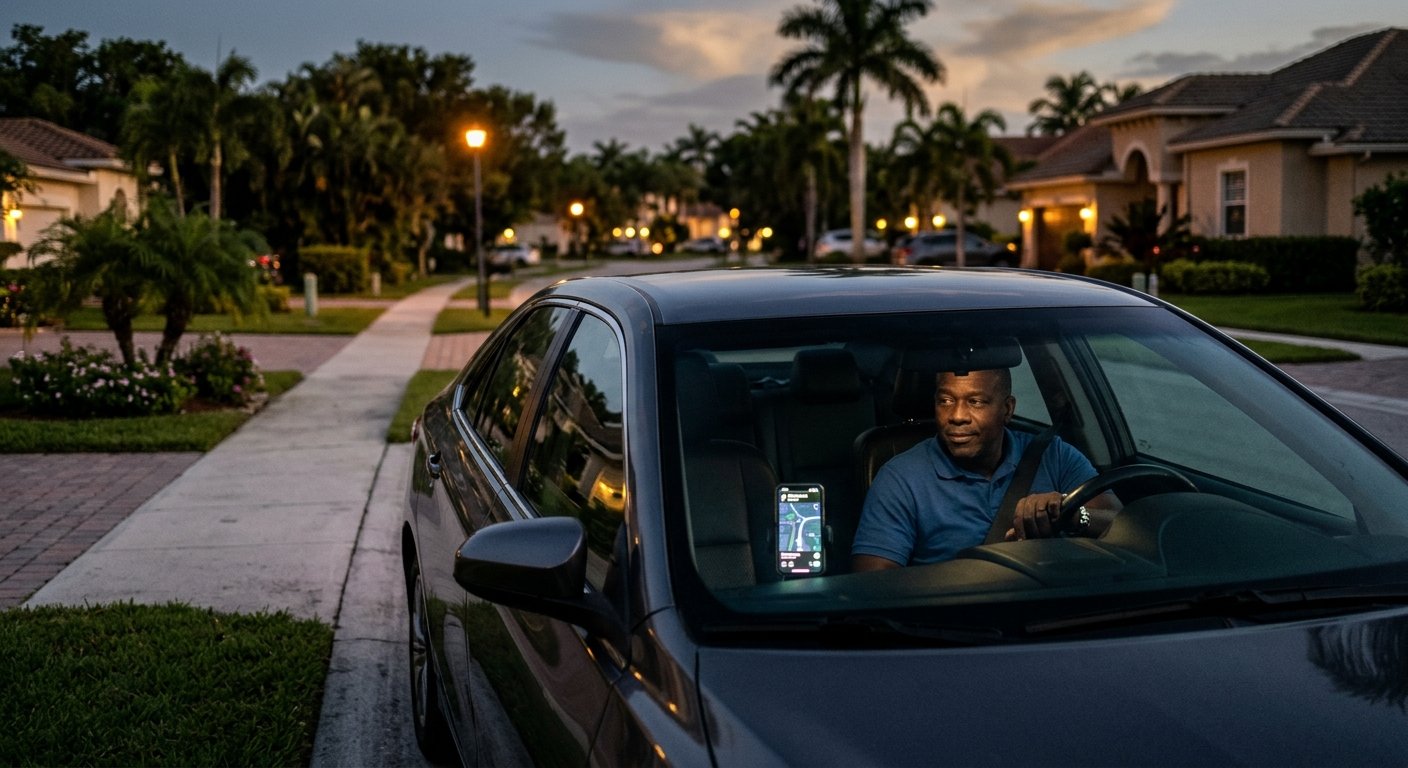
Florida’s Transportation Network Company statute, Fla. Stat. § 627.748, establishes the three-period framework that governs every Uber and Lyft trip in the state. Many injured riders and drivers in Broward County are surprised to learn that the rideshare company’s policy does not automatically apply the moment a driver turns on the app. The statute ties coverage to the driver’s status at the time of the crash.
Period 1 — App On, No Ride Accepted
The driver is logged into the platform but has not yet accepted a trip request. Under § 627.748, the driver or the TNC must carry primary coverage of at least $50,000 per person and $100,000 per incident for bodily injury, and $25,000 for property damage. The driver’s personal auto policy may also apply, though most personal policies exclude commercial activity.
Period 2 — Ride Accepted, En Route to Passenger
Once the driver accepts a trip and is driving toward the pickup location, § 627.748 requires primary liability coverage of at least $1,000,000 for death, bodily injury and property damage, carried by the driver, the TNC, or both. This is a significant jump from Period 1 and is the layer most relevant to third parties struck by a rideshare driver heading to a pickup.
Period 3 — Passenger On Board
From the moment a passenger enters the vehicle until the ride is completed, the same $1,000,000 minimum applies, along with uninsured and underinsured motorist coverage as required by Fla. Stat. § 627.727. It protects both the passenger and people injured in other vehicles.
How Florida PIP Intersects with Rideshare Claims

Florida is a no-fault state, which means that regardless of who caused the crash, your own Personal Injury Protection coverage responds first. Under Fla. Stat. § 627.736(1), PIP pays 80 percent of reasonable medical expenses and 60 percent of lost wages, up to a combined limit of $10,000 — but only if you sought initial medical care within 14 days of the crash and a licensed provider determined you suffered an emergency medical condition. If no emergency medical condition is found, medical benefits are capped at $2,500.
For rideshare passengers who do not own a vehicle and therefore carry no personal PIP policy, the rideshare driver’s PIP coverage may apply. If the driver’s policy does not extend to passengers, the TNC’s policy may fill the gap. Because these determinations require a careful review of overlapping policies, injured riders in Fort Lauderdale and throughout Broward County benefit from legal counsel before submitting any insurance claim.
PIP’s $10,000 limit is exhausted quickly in crashes involving hospitalization or surgery. Once PIP is spent, the injured person must pursue the at-fault driver’s liability coverage or the TNC’s policy for remaining medical costs and non-economic losses such as pain and suffering. Do not assume PIP alone will cover your expenses.
Who Can Be at Fault — and How Florida’s Comparative Fault Law Applies

Florida’s modified comparative fault rule, codified at Fla. Stat. § 768.81(6), bars any claimant who is found more than 50 percent responsible for their own injuries from recovering any damages. In rideshare crashes, fault can be distributed among the rideshare driver, another motorist, a government entity responsible for road maintenance, or even a vehicle manufacturer if a defect contributed to the crash. Identifying every responsible party matters because each one represents a potential source of compensation.
If you were a passenger and contributed nothing to the collision, the comparative fault bar is unlikely to affect your claim. However, if you were a driver or pedestrian and questions arise about your conduct, the allocation of fault becomes a central issue. An experienced motor vehicle accident attorney in Broward County will gather evidence — trip data, GPS records, dash-cam footage, and witness statements — to establish an accurate picture of how the crash occurred.
Identifying every responsible party matters because each one represents a potential source of compensation.
Steps to Take After a Rideshare Crash in Broward County
Broward County’s 17th Judicial Circuit handles civil litigation arising from crashes on I-95, the Florida Turnpike, US-1, and Broward’s surface roads where rideshare activity is concentrated. The steps you take in the days immediately following a crash directly affect the evidence available to support your claim.
Document the Scene and the App
Photograph vehicle damage, visible injuries, the crash location, and road conditions. Take a screenshot of the Uber or Lyft app showing trip status — this establishes which coverage period applies.
Seek Medical Care Promptly
Florida’s PIP law requires treatment within 14 days of the crash. Do not delay evaluation even if symptoms seem minor — some injuries, including soft-tissue damage and mild traumatic brain injury, worsen over time.
Preserve All Records
Keep every medical bill, prescription receipt, and record of missed work. These documents form the factual foundation of any claim for economic damages.
Consult an Attorney Before Speaking to Any Adjuster
Both the rideshare company’s insurer and the at-fault driver’s insurer will contact you. Statements you make — even seemingly routine ones — can limit your recovery. Retain counsel first.
Florida’s two-year statute of limitations for negligence claims applies to rideshare accident cases under Fla. Stat. § 95.11(5)(a) for claims arising after March 24, 2023. Missing this deadline forfeits your right to pursue compensation entirely. Consult an attorney well before this deadline — do not wait until the filing date approaches.
Why Rideshare Claims Are More Complex Than Standard Car Accident Claims
A standard two-car collision typically involves two insurance policies. A rideshare crash can involve the driver’s personal auto policy, the TNC’s commercial policy across multiple coverage periods, and potentially underinsured motorist coverage from multiple sources. Each insurer has an interest in minimizing its exposure, which means coverage disputes between insurers are common.
Uber and Lyft also retain significant data — GPS trip records, driver logs, and app activity — that can be critical to proving the applicable coverage period and establishing the driver’s conduct at the time of the crash. Obtaining this data often requires a formal legal preservation demand. DiStefano Law represents injured clients throughout Florida from its Broward County office and is experienced in pursuing these records as part of a thorough investigation.
For additional guidance on protecting your claim from the outset, review the common errors outlined in our article on mistakes that can damage a Florida injury claim — many of them apply directly to rideshare accident cases.
If you were injured as a passenger, driver, cyclist, or pedestrian in a rideshare-involved crash, our rideshare accident practice page provides an overview of how these cases are handled. Residents of Fort Lauderdale and surrounding Broward County communities can also visit our Fort Lauderdale service page for location-specific information.
Frequently Asked Questions
Does my own PIP coverage apply if I was a passenger in an Uber or Lyft?
Yes, if you own a vehicle in Florida and carry PIP coverage, your policy typically responds first for your medical expenses and lost wages regardless of where the crash occurred — including as a rideshare passenger. If you do not own a vehicle, the rideshare driver’s PIP or the TNC’s policy may provide coverage. The specific order of priority depends on the policies involved, which is why a legal review is advisable.
What if the Uber or Lyft driver was uninsured or underinsured?
Florida law requires TNCs to provide uninsured and underinsured motorist coverage during Periods 2 and 3 of a trip. This means that even if the at-fault driver carried no personal insurance or insufficient coverage, the rideshare company’s UM/UIM policy should apply to bridge the gap up to the policy limit. The specific limit and conditions depend on the TNC’s current policy terms.
Can I sue Uber or Lyft directly for the driver’s negligence?
Rideshare companies generally classify their drivers as independent contractors, which limits direct vicarious liability claims against Uber or Lyft in most circumstances. However, their commercial insurance policies are still required to respond during active trip periods under Florida’s TNC statute. In some cases, direct claims against the TNC may be viable — for example, if negligent hiring or retention of the driver contributed to the crash.
How long do I have to file a rideshare accident claim in Florida?
Florida’s general negligence statute of limitations is two years from the date of the crash for claims arising after March 24, 2023, under Fla. Stat. § 95.11(5)(a). Claims against government entities require a written notice within three years under Fla. Stat. § 768.28(6), with separate procedural requirements. Do not delay in consulting an attorney — evidence deteriorates and TNC trip data may not be preserved indefinitely.
Should I accept the first settlement offer from the rideshare company’s insurer?
No. Initial settlement offers are typically extended before the full extent of your injuries, future medical needs, and lost earning capacity are known. Accepting a settlement releases all future claims arising from the crash, even if your condition worsens. You should have an attorney review any offer before signing any release.
Injured in a Rideshare Crash? Speak with an Attorney First.
DiStefano Law offers a free consultation with no fee unless we recover for you — so you can get answers about your coverage and your rights before making any decisions.

Robert DiStefano, Esq.
For more than 40 years, Robert DiStefano has represented South Florida accident victims in claims against insurance carriers. From his Fort Lauderdale office, he has personally handled motor vehicle, premises liability, medical malpractice, catastrophic injury, aviation, and wrongful death cases — recovering more than $100 million for the people he represents. More about Robert →