

When Paradise Turns Painful: Understanding Your Rights After an Injury
South Florida injury law protects residents and visitors who suffer harm due to another’s negligence. Whether you’ve been hurt in a car accident, slip and fall, or medical malpractice incident, Florida law provides a framework for seeking compensation for medical bills, lost wages, pain and suffering, and other damages.
Key facts about South Florida injury law:
- Statute of Limitations: You have 2 years from the date of injury to file most personal injury lawsuits (for accidents after March 24, 2023).
- No-Fault Auto Insurance: Florida requires drivers to carry Personal Injury Protection (PIP), covering 80% of medical expenses and 60% of lost wages regardless of fault.
- 14-Day Medical Rule: You must seek treatment within 14 days of a car accident to qualify for PIP benefits.
- Comparative Negligence: You can still recover damages if you’re partially at fault, but your compensation is reduced by your percentage of responsibility (up to 50%).
- No Upfront Costs: Most injury lawyers work on contingency, meaning you pay nothing unless you win.
South Florida’s congested highways, heavy tourism, and dense population contribute to thousands of accidents annually. When an injury occurs—from a car crash, a slip and fall, or medical error—victims face mounting bills, lost income, and complex insurance negotiations. The legal system, with its deadlines and insurance company tactics, can feel overwhelming.
This guide cuts through the confusion. We’ll explain your rights, outline the steps to take after an injury, detail common case types, and reveal how to counter insurance company strategies. You’ll learn what damages you can pursue and why an experienced attorney is crucial for your recovery.
At DiStefano Law LLC, we’ve been helping injured South Florida residents steer the complexities of south florida injury law for over 40 years, securing millions for our clients. Our team combines deep knowledge of Florida’s statutes with compassionate, personalized service, fighting for the compensation you deserve while you focus on recovery.
Simple south florida injury law glossary:
- Fort Lauderdale car accident
- florida personal injury attorney
- malpractice attorney Fort Lauderdale
First Steps After an Accident: Protecting Your Rights in South Florida
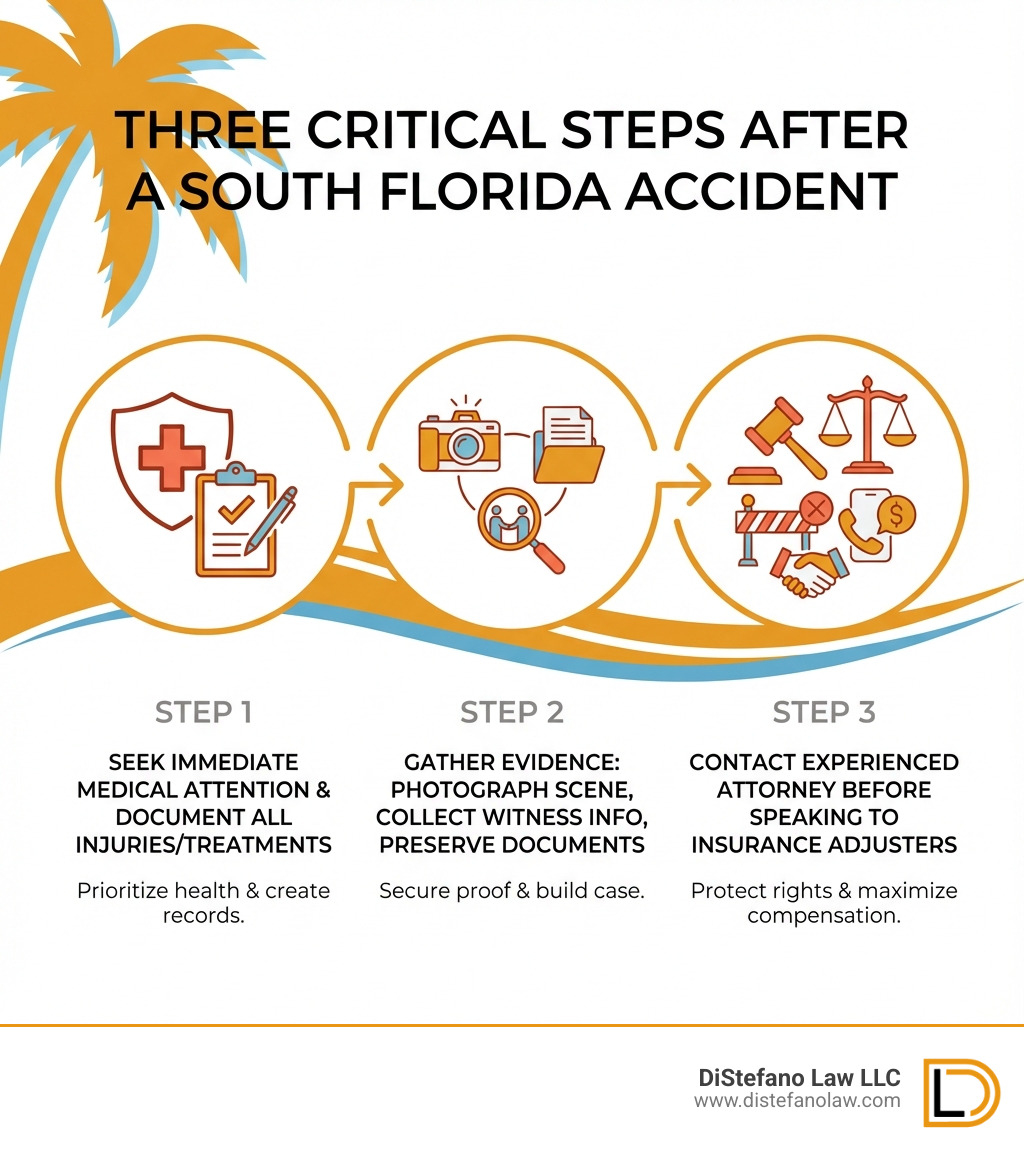
When an accident strikes in South Florida, the moments immediately following are crucial. What you do—or don’t do—can significantly impact your health and any potential personal injury claim. Your well-being is the priority, but taking the right legal steps protects your future.

Immediate Actions:
After ensuring everyone’s safety, take these critical steps:
- Call 911: Report the accident to law enforcement and request paramedics. An official report and immediate medical assessment are vital for documenting the incident and your injuries.
- Exchange Information: Safely get contact and insurance details from all parties involved, including names, phone numbers, policy numbers, and vehicle information.
- Document the Scene: Use your phone to take photos and videos of vehicle damage, road conditions, traffic signs, and any visible injuries. More evidence is always better.
- Gather Witness Information: Politely ask any witnesses for their contact information. Their unbiased accounts can be invaluable.
Common Mistakes to Avoid:
In the stress of the moment, it’s easy to make missteps that could harm your claim.
- Admitting Fault: Avoid apologizing or saying anything that implies responsibility. The full circumstances are rarely clear at the scene.
- Giving Recorded Statements: Politely decline to give a recorded statement to any insurance adjuster until you have spoken with an attorney. These statements can be used against you.
- Posting on Social Media: Do not post about the accident or your injuries online. Insurers monitor social media to find evidence to weaken your claim.
- Delaying Medical Care: This is a critical mistake. Any delay gives insurance companies an opening to argue your injuries aren’t serious or weren’t caused by the accident.
The 14-Day PIP Law: Florida’s No-Fault System
Florida’s “no-fault” auto insurance system means your own Personal Injury Protection (PIP) is the first source of compensation. A crucial rule is that you must seek initial medical attention within 14 days of a car accident. If you fail to do so, you will lose your right to PIP benefits, which cover 80% of medical bills and 60% of lost wages up to your policy limit (typically $10,000).
Delaying treatment also creates “gaps in treatment” that insurers exploit to devalue your claim.
For more information and guidance, you can always learn more about our Florida Injury Law Firm.
Importance of Legal Advice:
Consulting an experienced personal injury attorney quickly is paramount. We handle evidence preservation, steer critical deadlines, and manage all communications with insurance companies, protecting you from their tactics and ensuring your rights are upheld.
Navigating the Legal Maze: Key Concepts in South Florida Injury Law
Understanding the fundamental principles of south florida injury law is essential for anyone seeking justice. Concepts like statutes of limitation and comparative negligence directly impact your ability to recover compensation.
The Critical Deadlines: Florida’s Statute of Limitations
Time is of the essence in personal injury claims. Florida imposes strict deadlines, known as statutes of limitations, for filing a lawsuit. Missing these can mean losing your right to compensation forever.
Following a significant change to the law, most personal injury lawsuits based on negligence (including car accidents and slip and falls) that occurred on or after March 24, 2023, have a two-year statute of limitations. If your accident happened before this date, the previous four-year deadline may apply.
For wrongful death claims, the statute of limitations is typically two years from the date of the victim’s passing. Given these tight and recently changed deadlines, consulting an attorney immediately is critical.
Understanding Fault: Florida’s Comparative Negligence Rule
Florida follows a “modified comparative negligence” rule. This means if you are partially at fault, your compensation is reduced by your percentage of fault. However, if you are found to be 51% or more at fault, you are barred from recovering any damages.
For example, if your damages are $100,000 but you were 20% at fault, you could recover $80,000. If you were 60% at fault, you would receive nothing. This rule makes it vital to have an attorney who can skillfully minimize any allocation of fault to you, as insurers will always try to shift blame.
The Claims Process and South Florida Injury Law
Navigating a personal injury claim is a multi-step process:
- Filing a Claim: Your attorney files a claim with the at-fault party’s insurer.
- Demand Letter: Once your medical treatment stabilizes, your lawyer sends a demand letter detailing your injuries, all related costs, and a compensation demand.
- Negotiation: Your attorney negotiates with the insurance adjuster, countering their attempts to minimize the payout.
- Filing a Lawsuit: If a fair settlement isn’t reached, a lawsuit is filed, initiating litigation (evidence exchange, depositions, etc.).
- Settlement or Trial: Most cases settle before trial. If not, the case proceeds to court for a judge or jury to decide the outcome.
If an insurance company denies your claim, it doesn’t mean your case is over. We can investigate the denial, gather more evidence, and challenge their decision through further negotiation or by taking your case to court.
For more detailed information, visit our page on Fort Lauderdale Personal Injury Lawyers.
Common Personal Injury Cases in the Sunshine State
South Florida’s dynamic environment leads to a wide array of personal injury cases. Our firm provides dedicated representation to victims across Fort Lauderdale, Boca Raton, Sunrise, and surrounding areas.
Vehicle and Traffic Accidents
With millions of residents and tourists, South Florida’s roads are a common site for accidents.
- Car Accidents: These are the most frequent claims, often caused by distracted driving, speeding, or DUI. In areas like Boca Raton, heavy traffic leads to significant injuries. Our Car Accident Attorney Boca Raton team is uniquely positioned to help victims steer these complex claims.
- Truck Accidents: Collisions with commercial trucks are often devastating. Causes include driver fatigue, improper loading, and violations of federal trucking regulations. Holding negligent companies accountable is a complex process. Learn more on our Truck Accidents page.
- Motorcycle, Bicycle & Pedestrian Accidents: Riders and pedestrians are incredibly vulnerable and often sustain catastrophic injuries. Insurers frequently try to shift blame, making experienced legal representation crucial. See our pages on Motorcycle Accidents, Bicycle Accidents, and Pedestrian Accidents.
- Rideshare & Scooter Accidents: Uber/Lyft accidents introduce complex insurance questions involving multiple policies. The rise in scooter injuries, especially in tourist areas, presents new risks. Our Florida Ridesharing Accidents page offers more insight.
Premises Liability: When Property Owners Are at Fault
Property owners have a legal duty to keep their premises safe. When they fail, they can be held liable.
- Duty of Care: The responsibility an owner owes depends on the visitor’s status (invitee, licensee, or trespasser). Customers in a store (invitees) are owed the highest duty of care. Explore this on our Premises Liability page.
- Slip and Fall Cases: Common on wet floors or uneven surfaces. A “wet floor” sign doesn’t automatically absolve an owner of responsibility, especially if they had “constructive notice”—meaning the hazard existed long enough that they should have known about it. More information is on our Slip and Falls page.
- Negligent Security: Inadequate security (e.g., poor lighting, broken locks) that leads to an injury from a criminal act can be grounds for a claim. See our Negligent Security page.
Other Important South Florida Injury Law Cases
- Medical Malpractice: When a healthcare professional’s negligence causes harm through misdiagnosis, surgical errors, or other mistakes, it may be malpractice. These cases are complex and require expert testimony. Our Medical Malpractice page provides a deeper dive.
- Workers’ Compensation vs. Personal Injury: If injured at work, you’re generally covered by workers’ comp, but you must report the injury to your employer within 30 days. If a third party caused your injury, you might also have a personal injury claim. See our Workers Compensation page.
- Product Liability: Manufacturers, distributors, or retailers can be liable for injuries caused by defective products. See our Product Liability page.
- Catastrophic Injuries & Wrongful Death: Severe, life-altering injuries (e.g., TBI, spinal cord injuries) require extensive compensation. Fatal accidents may lead to wrongful death claims by surviving family. Learn more about Catastrophic Accidents and Wrongful Death.
- Maritime Law (Jones Act): Injuries at sea, including on cruise ships or boats, are covered by specialized maritime laws. Visit our Shipping Boating Accidents page.
Understanding Compensation: Damages and Insurance Company Tactics
When you’re injured by someone’s negligence, you must understand the compensation you can pursue and the tactics insurers use. At DiStefano Law LLC, our goal is to secure the full compensation you deserve under south florida injury law.
Types of Damages:
Compensation is divided into two main categories:
- Economic Damages: These are quantifiable financial losses with a specific monetary value, such as:
- Past and future medical bills
- Lost wages and loss of future earning capacity
- Property damage and other out-of-pocket expenses
- Non-Economic Damages: These are subjective losses that compensate for the impact on your quality of life, including:
- Pain and suffering
- Emotional anguish and mental distress
- Loss of enjoyment of life
- Disfigurement or loss of consortium
Calculating Pain and Suffering:
Unlike bills, pain and suffering are hard to quantify. Attorneys often use a multiplier method (multiplying economic damages by a factor based on injury severity) or a per diem (daily rate) method. The final amount depends on the severity of your injuries, their impact on your life, and the strength of your medical documentation.
Insurance Company Tactics:
Insurers are for-profit businesses that use tactics to minimize payouts:
- Claim Valuation Software: Many use programs like Colossus, which rely on algorithms that often undervalue claims and generate lowball offers.
- Quick, Low Settlements: Adjusters may offer a fast, small payout, hoping you’ll accept before knowing the full value of your claim.
- Downplaying Injuries: They frequently try to minimize the severity of “soft tissue” injuries like whiplash or sprains, despite their potential for causing chronic pain.
- Challenging Injury Claims: Insurers often dispute the cause or necessity of treatment for injuries like shoulder damage from car accidents or ankle fractures from falls, linking them to pre-existing conditions to avoid payment.
Settlement Payouts:
Settlements are typically paid as a lump sum (one single payment) or a structured settlement (payments over time). Attorney’s fees and case costs are deducted from the settlement before you receive your portion.
| Damage Type | Economic Damages | Non-Economic Damages |
|---|---|---|
| Definition | Tangible, quantifiable financial losses | Intangible, subjective losses impacting quality of life |
| Examples | Medical bills, lost wages, property damage, future medical care, out-of-pocket expenses | Pain and suffering, emotional distress, mental anguish, loss of enjoyment of life, disfigurement, loss of consortium |
| Calculation | Based on actual receipts, invoices, wage statements, expert projections | Often based on multipliers of economic damages, per diem rates, or jury discretion |
| Proof | Requires documentation (bills, pay stubs, repair estimates) | Requires testimony (your own, family, friends), medical records detailing pain, psychological evaluations |
Frequently Asked Questions About South Florida Injury Law
We understand you have many questions after an accident. Here are answers to some of the most common inquiries about south florida injury law.
How long do I have to file a personal injury lawsuit in Florida?
For most negligence-based personal injury claims (like car accidents or slip and falls) that occurred on or after March 24, 2023, you have two years to file a lawsuit. For accidents before that date, a four-year deadline may apply. The statute of limitations for wrongful death claims is generally two years from the date of passing. Because these deadlines are strict, it is crucial to consult an attorney immediately to protect your rights.
How much does it cost to hire a personal injury lawyer?
At DiStefano Law LLC, we work on a contingency fee basis. This means you pay no upfront costs to hire us. We only get paid if we successfully recover compensation for you, either through a settlement or a court award. Our fee is a percentage of the final amount, which allows everyone to access experienced legal representation regardless of their financial situation.
Can I still get compensation if I was partially at fault?
Yes. Under Florida’s modified comparative negligence rule, you can recover damages if you were partially at fault, as long as your share of the blame is 50% or less.
Your total compensation will be reduced by your percentage of fault. For example, if you have $100,000 in damages but are found 25% at fault, you would receive $75,000. However, if you are found 51% or more at fault, you are barred from recovering any damages. This makes it critical to have a skilled attorney to minimize any blame assigned to you.
Why an Experienced Attorney is Your Best Ally
When you’re dealing with an injury, navigating south florida injury law alone is overwhelming. An experienced personal injury attorney is your most valuable ally.
- Leveling the Playing Field: Insurance companies have teams dedicated to minimizing your payout. We have decades of experience fighting their tactics and advocating for victims.
- Maximizing Compensation: We accurately value your claim, including all current and future damages, to negotiate the highest possible settlement or verdict.
- Navigating Complexity: We handle every intricate detail of the legal process—from paperwork and deadlines to evidence gathering and litigation—so you don’t have to.
- Peace of Mind: You can focus on healing while we focus on protecting your rights and securing your financial future.
The benefits of hiring a Florida Personal Injury Attorney are clear. With over 40 years of experience, the team at DiStefano Law LLC provides the compassionate, personalized service needed to steer a complex personal injury claim while fighting for the successful outcome you deserve. We serve communities across Fort Lauderdale, Lauderhill, Wilton Manors, Sunrise, and Boca Raton.
If you’ve been in a car accident in Boca Raton, you need an attorney who understands Florida’s laws and has deep familiarity with the local courts. We are those attorneys, dedicated to being the best advocate for car accident victims in Boca Raton and throughout South Florida.
Take the first step towards justice and recovery. Contact us for a free consultation on your personal injury case today.