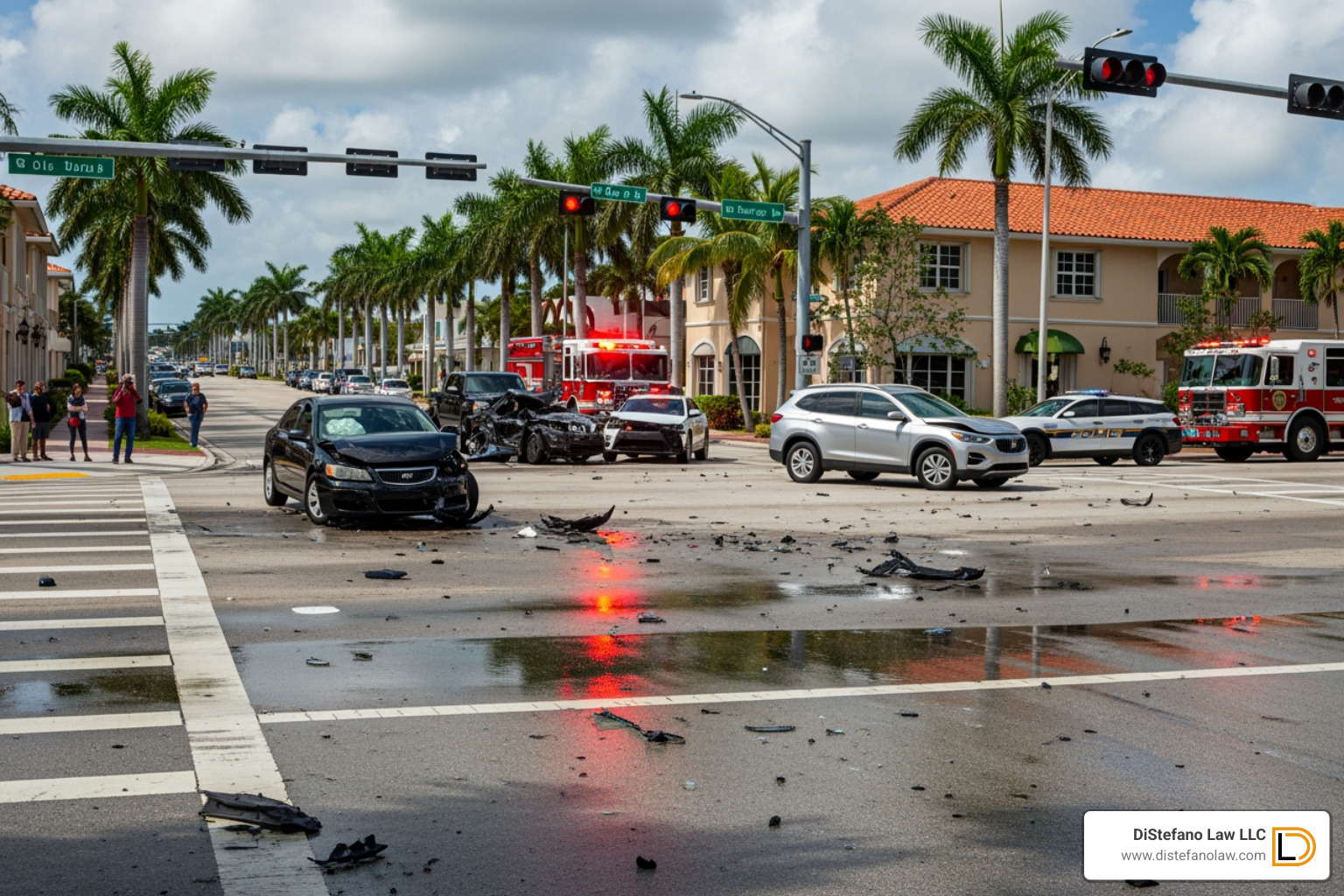

Understanding Your Legal Rights After a Fort Lauderdale Accident
Fort Lauderdale personal injury cases can arise from car crashes, slip and falls, boating accidents, or any incident where someone else’s negligence causes you harm. Here’s what you need to know right away:
Quick Overview: Fort Lauderdale Personal Injury Essentials
- What it is: A legal claim seeking compensation when you’re injured due to another party’s negligence
- Common cases: Car accidents, truck collisions, slip and falls, motorcycle crashes, pedestrian accidents, and boating incidents
- Florida’s no-fault rule: Your own insurance (PIP) covers initial medical bills up to $10,000, but you can sue for serious injuries
- Time limit: You have 2 years from the accident date to file a lawsuit in most cases
- What you can recover: Medical expenses, lost wages, pain and suffering, and property damage
- Cost to hire a lawyer: Most personal injury attorneys work on contingency—no fee unless you win
A personal injury can turn your life upside down, leaving you with mounting medical bills, lost wages, and ongoing pain. The risks are especially high for Fort Lauderdale residents, as Broward County ranks in the top 3 counties for crashes in Florida, and the city has one of the highest pedestrian death rates in the state. In the aftermath, you’re not just dealing with physical pain but also with insurance companies aiming to minimize payouts. Many victims accept low settlements because they don’t know their rights or what they’re truly owed.
DiStefano Law LLC has been a proven advocate for accident victims in Fort Lauderdale, Boca Raton, and across South Florida for more than 40 years, securing millions for our clients. Our attorneys understand the unique challenges of Fort Lauderdale personal injury cases, from high-traffic intersections to waterway accidents, and we’re here to guide you through every step of your recovery.
Common Fort Lauderdale personal injury vocab:
- Fort Lauderdale car accident
- malpractice attorney Fort Lauderdale
- wrongful death attorney Fort Lauderdale
What to Do Immediately After an Accident in Fort Lauderdale
Accidents happen in the blink of an eye, but what you do in the moments and days afterward can significantly impact your future and the strength of any potential personal injury claim. Taking the right steps immediately following an incident in Fort Lauderdale is crucial for your health and your legal rights.

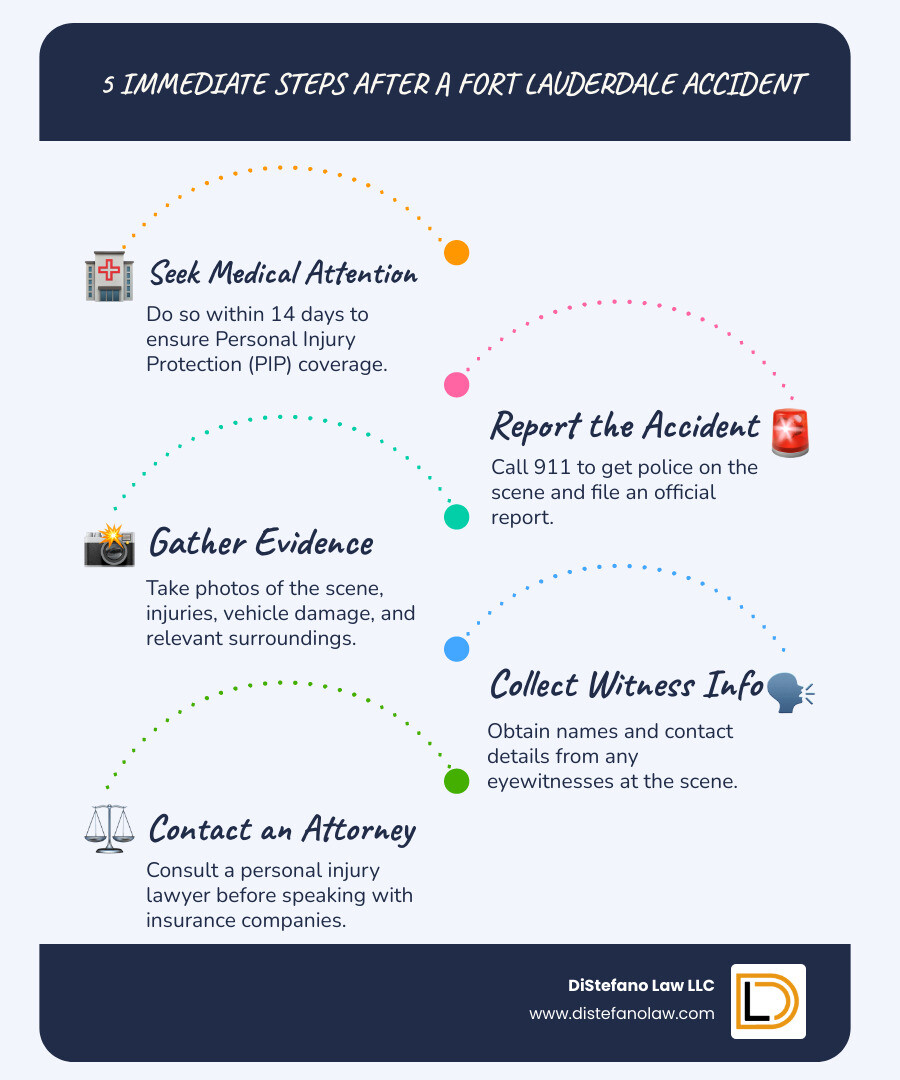
Your health is the top priority. Seek medical attention immediately after any accident, even if you feel fine. Some serious injuries, like whiplash or internal bleeding, have delayed symptoms. A prompt medical evaluation creates a vital official record for your Fort Lauderdale personal injury case and is required to qualify for PIP benefits—you must see a doctor within 14 days of a vehicle accident.
Next, report the accident to the authorities. For car accidents, call 911 to ensure a police report is filed. This official document can be an invaluable piece of evidence, detailing the scene, involved parties, and initial observations.
While at the scene, if your condition allows, gather as much evidence as possible. This includes taking photographs and videos of:
- The accident scene from multiple angles
- Vehicle damage
- Any visible injuries you or others sustained
- Road conditions, traffic signs, or anything that might have contributed to the accident
- The other driver’s license plate, vehicle registration, and insurance information
Also, speak to any eyewitnesses. Their unbiased accounts can be incredibly powerful. Collect their names and contact information.
Crucially, do not admit fault to anyone—not to the other driver, not to the police, and especially not to insurance adjusters. You might not have all the facts, and admitting fault could jeopardize your ability to recover compensation later.
Finally, start documenting your injuries and recovery process in a personal injury journal. Record details of your pain, doctor’s visits, medications, physical therapy, and how your injuries affect your daily life. This helps us understand the full impact of the accident on your well-being.
Building Your Evidence File
Building a strong Fort Lauderdale personal injury case is like assembling a puzzle; each piece of evidence contributes to a complete picture of what happened and who was responsible. Our firm, with over 40 years of experience, emphasizes thorough evidence collection.
Here’s what you’ll need:
- Medical records and doctor’s notes: Documents your injuries, treatments, and prognosis, linking them to the accident.
- Police reports: Provides an official, objective account of a traffic accident, including diagrams and citations.
- Eyewitness statements: Independent accounts that corroborate your version of events.
- Scene photos and videos: Captures the immediate aftermath, including vehicle positions and road conditions.
- Vehicle damage photos: Illustrates the force of impact, supporting the severity of your injuries.
- Pay stubs for lost wages: Documents your income to help calculate lost earnings if you cannot work.
- Receipts for expenses: Tracks all accident-related costs, like co-pays and transportation for appointments.
Common Mistakes to Avoid
The path to recovery after a Fort Lauderdale personal injury can be fraught with pitfalls. Avoiding common mistakes is just as important as taking the right steps.
- Delaying medical care: This can harm your health and your case. Insurers may argue your injuries aren’t severe or related to the accident if you wait to see a doctor.
- Admitting fault: A simple “I’m sorry” can be used against you to deny your claim. Stick to the facts and let professionals determine liability.
- Giving recorded statements to insurers without legal advice: Adjusters aim to protect their company’s bottom line, not you. Their questions are designed to minimize your claim. Always consult with us first.
- Accepting a quick settlement: Insurers may offer a lowball settlement before you know the full extent of your injuries and costs. Accepting it forfeits your right to seek more compensation later.
- Posting on social media: Anything you post can be used by opposing parties to argue your injuries aren’t as serious as you claim. It’s best to stay offline during your case.
- Not contacting an attorney: An experienced Fort Lauderdale personal injury attorney significantly improves your chances of fair compensation. We handle the legal complexities and negotiations so you can focus on healing.
Your Fort Lauderdale Personal Injury Claim: Common Cases and Unique Risks
A personal injury claim in Fort Lauderdale arises when you suffer harm due to someone else’s negligence. In legal terms, it means that another party failed to exercise reasonable care, and this failure directly caused your injuries. To prove negligence, we typically look for four elements:
- Duty of care: The other party owed you a legal duty to act reasonably (e.g., a driver has a duty to obey traffic laws).
- Breach of duty: The other party failed to uphold that duty (e.g., a driver ran a red light).
- Causation: This breach directly led to your injuries.
- Damages: You suffered actual harm or losses as a result.
Once negligence is established, we can pursue compensation for your damages. Fort Lauderdale personal injury cases cover a wide array of incidents. Here are some of the most common types we handle:
- Car Accidents
- Truck Accidents
- Motorcycle Accidents
- Bicycle Accidents
- Pedestrian Accidents
- Uber and Lyft Accidents
- Slip and Fall Accidents
- Premises Liability
- Negligent Security
- Medical Malpractice
- Wrongful Death
- Product Defects
- Boating Accidents
- Construction Accidents
Traffic-Related Accidents in a High-Risk County
Florida is one of the top states for vehicle accidents, and Broward County is among the top 3 counties for crashes in Florida. This makes Fort Lauderdale and its surrounding areas, including Boca Raton, hotspots for traffic-related personal injuries.
In 2021, Broward County recorded a staggering 400,431 car accidents. We also saw 822 motorcycle accidents, 1,037 pedestrian accidents, and 602 bicycle accidents in the same year. These statistics underscore the daily risks faced by all road users. Distracted driving is a major contributing factor, with the National Safety Council reporting 1 in 4 crashes involves cell phones.
Fort Lauderdale’s busy roads, tourist traffic, and high population density contribute to these alarming numbers. The city has one of the highest pedestrian death rates in the state, a fact highlighted by Smart Growth America’s “Dangerous by Design” report. The Miami-Fort Lauderdale-West Palm Beach metro area is ranked among the most dangerous for pedestrians in the nation.
Certain intersections in Fort Lauderdale are notorious for accidents:
- Sunrise Boulevard and Federal Highway (US-1)
- Oakland Park Boulevard and Dixie Highway
- Sunrise Boulevard and Powerline Road
- Commercial Boulevard and Andrews Avenue
- Broward Boulevard and Northwest 31st Avenue
- Cypress Creek Road and Powerline Road
- Davie Boulevard and Southwest 31st Avenue
These areas, characterized by high traffic volume and complex intersections, pose significant risks. If you’ve been injured in any of these locations, our Fort Lauderdale personal injury team is well-versed in the local nuances that can impact your case.
Premises Liability: Slip, Trip, and Fall Claims
Property owners in Fort Lauderdale have a legal duty to keep their premises safe for visitors. If you are injured in a slip and fall at a hotel, restaurant, or store because they failed in this duty, you may have a premises liability claim. Slip and fall incidents are particularly common in tourist-heavy areas where spills, uneven surfaces, or poor lighting can lead to serious injuries. Beyond slip and falls, negligent security claims can arise if you’re harmed due to inadequate security measures at a property.
Proving owner negligence requires demonstrating that the property owner knew or should have known about the dangerous condition but failed to fix it. This is a specific requirement under Florida Statute 768.0755. Our firm understands these legal standards and how to meet the proof burdens for a successful claim.
Unique Fort Lauderdale Scenarios
Fort Lauderdale’s unique geography and lifestyle also give rise to specific types of personal injury cases. Our city, known as the “Venice of America,” naturally sees its share of:

- Boating Accidents: Florida leads the nation in boating accidents, often caused by operator inattention or inexperience. From Intracoastal Waterway collisions to jet ski incidents, we handle the complexities of maritime law.
- Rideshare (Uber/Lyft) Accidents: Accidents involving Uber and Lyft are common and present unique challenges with complex insurance policies and liability issues, which our firm is equipped to handle.
- Tourist-Related Injuries: As a top tourist destination, Fort Lauderdale sees accidents involving rental cars, hotels, and recreational activities. We are experienced in managing claims for out-of-state visitors.
- Construction Accidents: Ongoing development leads to construction site injuries for workers and the public. These cases can involve complex regulations and multiple at-fault parties.
Navigating Florida’s Complex Personal Injury Laws
After an accident, you might feel overwhelmed by medical appointments, mounting bills, and the daunting prospect of dealing with insurance companies. This is where navigating Florida’s complex personal injury laws becomes critical. Insurance companies are businesses, and their primary goal is to minimize payouts. They may employ tactics like offering quick, low settlements or prolonging the process to financially strain you. Protecting your rights means understanding the legal landscape.
Florida’s No-Fault System and PIP Insurance
Florida operates under a “no-fault” insurance system for vehicle accidents. This means that if you’re involved in a car or motorcycle accident, your own Personal Injury Protection (PIP) insurance is the first line of defense for your medical bills and lost wages, regardless of who was at fault.
Your PIP policy typically provides up to $10,000 in coverage for 80% of your medical expenses and 60% of your lost wages. However, to qualify for these benefits, you must seek initial medical treatment within 14 days of the accident. While PIP is designed to provide quick access to funds, it has limitations. The $10,000 limit is often insufficient for serious injuries, and it doesn’t cover non-economic damages like pain and suffering or property damage.
This is where the “serious injury threshold” comes into play. If your injuries meet Florida’s definition of a “permanent injury,” significant scarring or disfigurement, or death, you may be able to step outside the no-fault system and file a lawsuit against the at-fault driver for full compensation, including pain and suffering. Determining if your injuries meet this threshold is a critical step in a Fort Lauderdale personal injury case.
The Statute of Limitations: Your Deadline to File
Time is of the essence in a Fort Lauderdale personal injury claim. Florida law imposes strict deadlines, known as the “statute of limitations,” for filing a lawsuit. For most personal injury claims arising from negligence, you generally have two years from the date of the accident to file a lawsuit against the negligent party.
If you fail to file within this two-year window, you typically lose your right to pursue compensation for your accident-related losses, no matter how strong your case. There are some exceptions, such as for wrongful death claims or certain medical malpractice cases, which may have different deadlines. The best way to ensure you meet all critical deadlines is to contact an experienced personal injury attorney as soon as possible after your accident. The sooner we can begin our investigation, the better we can protect your claim.
How Florida’s Comparative Negligence Affects Your Claim
It’s common for accident victims to wonder, “What if I was partially at fault for the accident?” Florida follows a modified comparative negligence law. This means that even if you share some blame for the accident, you can still recover damages, but your compensation will be reduced by your percentage of fault.
For example, if a jury determines your total damages are $100,000, but finds you were 20% at fault for the accident, your award would be reduced by 20%, leaving you with $80,000. However, there’s a crucial limit: if you are found to be more than 50% at fault, you are barred from recovering any damages from the other party.
Determining fault can be complex, involving accident reconstruction, witness testimony, and careful analysis of evidence. Insurance companies will often try to shift as much blame as possible onto you to minimize their payout. Our role is to carefully investigate the accident, gather evidence to prove the other party’s fault, and protect you from unfair accusations of comparative negligence.
Working with an Attorney and Determining Your Claim’s Value
When you’re dealing with the aftermath of an accident, figuring out how much your claim is worth and navigating the legal system can feel like climbing Mount Everest. That’s where an experienced Fort Lauderdale personal injury attorney comes in. We level the playing field against large insurance companies and ensure you receive maximum compensation for your losses.
What Compensation Can You Recover in a Fort Lauderdale Personal Injury Case?
The value of a personal injury case is determined by various factors, including the severity of your injuries, the impact on your life, and the clarity of liability. Compensation typically falls into two main categories: economic and non-economic damages.
| Category | Type of Damage | Description |
|---|---|---|
| Economic Damages | Medical Expenses (Past & Future) | Costs for doctor visits, hospital stays, surgeries, medications, rehabilitation, and long-term care. |
| Lost Wages | Income lost due to inability to work after the accident. | |
| Loss of Earning Capacity | Compensation for future income you can no longer earn due to permanent injury or disability. | |
| Property Damage | Cost to repair or replace damaged property, such as your vehicle. | |
| Out-of-Pocket Expenses | Any other costs directly related to the accident, like transportation to medical appointments. | |
| Non-Economic Damages | Pain and Suffering | Compensation for physical pain, discomfort, and mental anguish caused by the injury. |
| Emotional Distress | Psychological impacts like anxiety, depression, PTSD, and fear. | |
| Loss of Enjoyment of Life | Compensation for the inability to participate in hobbies, activities, or daily functions you once enjoyed. | |
| Scarring and Disfigurement | Damages for permanent physical alterations and their emotional impact. | |
| Loss of Consortium (in wrongful death cases) | Compensation for the loss of companionship, affection, and support from a deceased loved one. |
Calculating pain and suffering damages is more subjective than economic damages, often based on factors like injury severity, impact on daily life, and medical expenses, sometimes using a multiplier of economic damages. Our Fort Lauderdale personal injury lawyers carefully evaluate all these aspects to ensure your claim reflects the full extent of your losses.
Why You Need a Fort Lauderdale Personal Injury Lawyer
While you can file a claim alone, an experienced attorney significantly improves your chances of receiving fair compensation. When you hire DiStefano Law LLC, you get a dedicated team of attorneys, staff, and investigators fighting for you. We serve clients in Fort Lauderdale, Boca Raton, and throughout South Florida, providing a comprehensive support system designed to maximize your recovery.
Here’s what we do for you:
- Investigating the case: We gather all evidence, including police reports, medical records, and witness statements, to build a strong claim.
- Calculating total damages: We assess all past and future costs, lost earning capacity, and pain and suffering to determine your claim’s full value.
- Negotiating with insurers: We handle all communications with insurance companies, protecting you from their tactics and fighting for a fair offer.
- Filing a lawsuit: If a fair settlement isn’t reached, we are fully prepared to file a lawsuit and pursue your case in court.
- Court representation: If your case goes to trial, we will skillfully advocate for your rights before a judge and jury.
Our goal is to level the playing field, allowing you to focus on your recovery while we fight for the justice and compensation you deserve.
Understanding Legal Fees: The Contingency Fee Model
One of the biggest concerns for accident victims is often the cost of hiring a lawyer. This is why our firm, like many Fort Lauderdale personal injury attorneys, works on a contingency fee basis.
What does “contingency fee” mean? It’s simple:
- No upfront costs: You don’t pay any legal fees out of your pocket before or during your case.
- No fee unless you win: We only get paid if we successfully recover compensation for you, either through a settlement or a court award.
- Percentage of settlement: Our fee is a pre-agreed percentage of the final settlement or verdict amount.
This arrangement allows you to pursue justice without financial burden or risk. It ensures that quality legal representation is accessible to everyone, regardless of their current financial situation. Our contingency fee agreements are transparent and comply with Florida Bar rules, as outlined in Florida Statute 57.105. We are confident in our ability to win your case, and this fee structure reflects that confidence.
Frequently Asked Questions about Fort Lauderdale Personal Injury Claims
We understand that you likely have many questions during this challenging time. Here are answers to some of the most common questions we receive regarding Fort Lauderdale personal injury claims.
How much is my personal injury case worth?
This is one of the most common questions, but also one of the hardest to answer without a thorough evaluation. The value of your Fort Lauderdale personal injury case depends on numerous factors, including:
- Severity of your injuries: More severe, long-lasting, or permanent injuries typically result in higher compensation.
- Medical costs: The total amount of your past and future medical expenses.
- Lost income: The wages you’ve lost and your potential future loss of earning capacity.
- Pain and suffering: The physical pain, emotional distress, and impact on your quality of life.
- Clarity of liability: How clearly the other party’s negligence can be proven.
- Available insurance limits: The amount of insurance coverage available from the at-fault party.
There’s no simple calculator for case value. The easiest way to know what your case might be worth is to discuss your specific situation with an experienced attorney. We can evaluate all these factors and provide a realistic assessment.
Will my personal injury case go to trial?
While every case is prepared as if it will go to trial, the vast majority of personal injury cases in Fort Lauderdale, and across Florida, are resolved through settlements before ever reaching a courtroom. This can happen through direct negotiation with the insurance company or through alternative dispute resolution methods like mediation.
However, if a fair settlement cannot be reached—because the insurance company is unwilling to offer adequate compensation, or there’s a dispute over fault or the extent of your injuries—we are fully prepared to take your case to trial. Our firm has a strong track record of success both in and out of the courtroom, and we will advocate aggressively on your behalf to achieve the best possible outcome, whether that’s a settlement or a verdict.
What are the most dangerous intersections in Fort Lauderdale?
Due to its high population density, tourist traffic, and busy roadways, Fort Lauderdale has several intersections known for a high incidence of accidents. Some of the most dangerous intersections we frequently see accident reports from include:
- Sunrise Boulevard and Federal Highway (US-1): A major thoroughfare with heavy traffic and complex turns.
- Oakland Park Boulevard and Dixie Highway: Another busy intersection with significant vehicle and pedestrian activity.
- Commercial Boulevard and Andrews Avenue: High traffic volumes contribute to frequent collisions here.
These areas often involve a combination of factors like high traffic volume, tourist unfamiliarity with local roads, and significant pedestrian activity, increasing the risk of serious accidents. If you’ve been involved in an accident at any of these or other dangerous locations in Fort Lauderdale, it’s crucial to seek legal guidance.
Take the First Step Toward Your Recovery
Facing a Fort Lauderdale personal injury claim alone is overwhelming. We hope this guide has clarified your rights and the legal process. Being informed about Florida’s laws, evidence collection, and common mistakes is your first line of defense.
At DiStefano Law LLC, we provide the personalized, compassionate service you deserve. With over 40 years of experience, we have a proven track record of helping accident victims in Fort Lauderdale, Boca Raton, and across South Florida. Whether you were in a car accident on I-95 or a slip and fall on Las Olas, we fight for your right to full compensation so you can focus on recovery.
Don’t let insurance companies intimidate you. Contact us for a free, no-obligation consultation to discuss your case and learn your options.
Get a free case evaluation for your personal injury claim