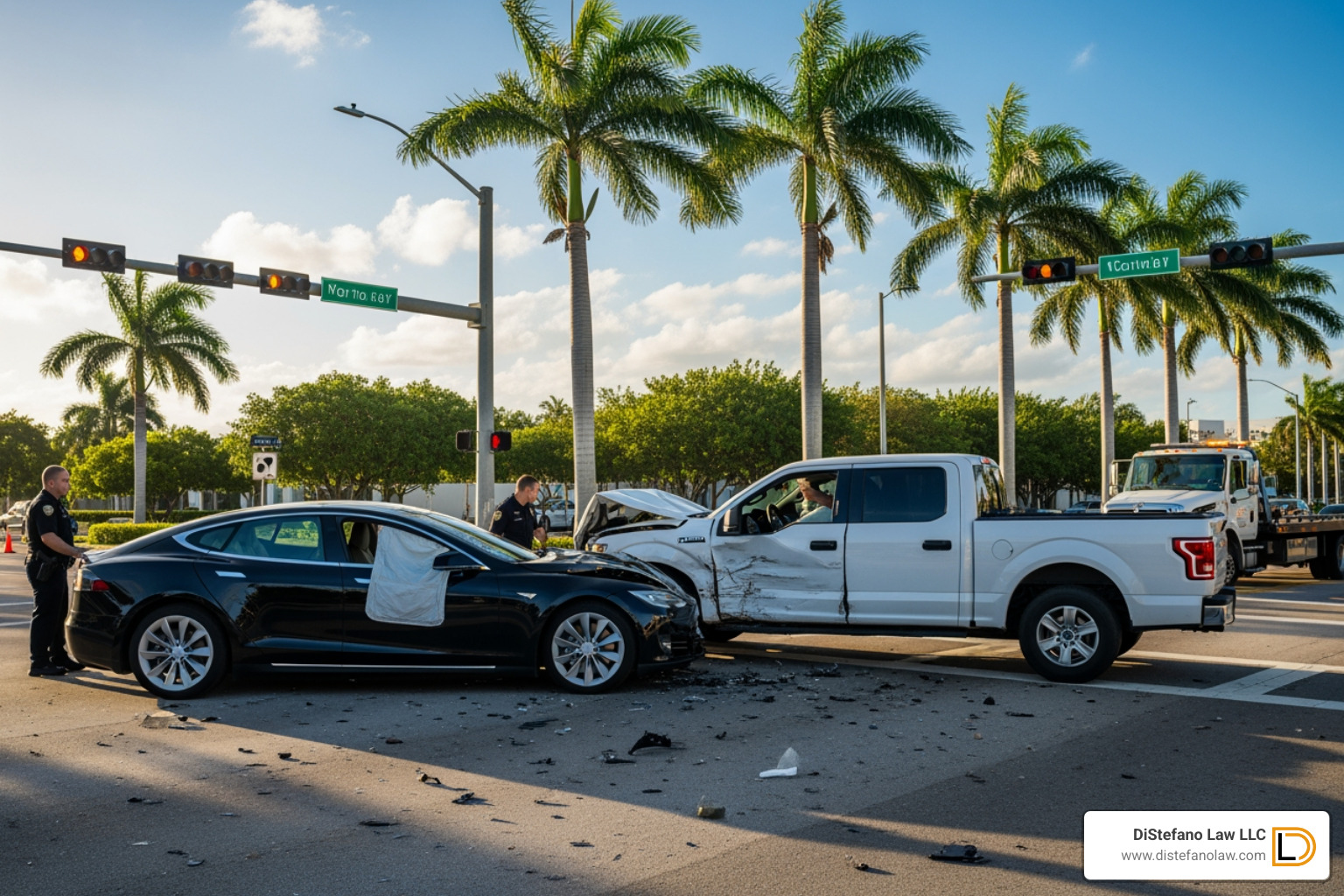

Why Acting Fast After a Fort Lauderdale Car Accident Matters
If you’ve been in a fort lauderdale car accident, knowing what to do next is critical. Your immediate priorities should be:
Essential First Steps After a Fort Lauderdale Car Accident:
- Ensure Safety – Move to a safe location and call 911 if anyone is injured.
- Report the Crash – Florida law requires reporting accidents with injuries or damage over $500.
- Document Everything – Take photos, get witness information, and exchange details with other drivers.
- Seek Medical Care – See a doctor immediately, as some injuries have delayed symptoms.
- Obtain the Police Report – Request it from the Fort Lauderdale Police Department or online via the Florida Crash Portal.
The statistics are sobering. In 2022, Broward County saw 40,836 traffic accidents, leading to 23,747 injuries and 274 deaths. Fort Lauderdale’s busy roads, from I-95 to Las Olas Boulevard, are frequent crash sites.
After a crash, you’re dealing with shock and potential injuries. Insurance companies will contact you quickly, hoping to settle for less than you deserve. The steps you take in the first few days can determine whether you receive fair compensation or are left with thousands in medical bills. It’s about protecting your health, rights, and financial future under Florida’s complex no-fault insurance system and two-year statute of limitations.
At DiStefano Law LLC, we have over 40 years of experience helping Fort Lauderdale residents steer the aftermath of car accidents. We’ve secured millions for clients and understand how to build a strong case against uncooperative insurance companies. This guide will walk you through everything you need to know to protect yourself and maximize your compensation.

Relevant articles related to fort lauderdale car accident:
- Fort Lauderdale catastrophic injury lawyer
- Fort Lauderdale distracted driving lawyer
- Fort Lauderdale pedestrian accident lawyer
Your First Steps: What to Do Immediately After a Fort Lauderdale Crash
The moments after a fort lauderdale car accident are chaotic, but your actions are critical for your safety and legal rights. Understanding Florida’s requirements helps build the foundation for a successful insurance claim or legal case.
Ensure Safety and Seek Medical Care
Your first priority is safety. If possible, move your vehicle out of traffic to the shoulder or a side street and turn on your hazard lights. Call 911 immediately if anyone is injured or vehicles are blocking the road. Let paramedics assess the situation, even if injuries seem minor.
Adrenaline can mask serious injuries like whiplash, concussions, or internal damage that may not show symptoms for hours or days. Seeking a medical evaluation as soon as possible is crucial for your health and your insurance claim. Under Florida’s Personal Injury Protection (PIP) rules, you must seek medical treatment within 14 days of the accident to remain eligible for benefits.
Report the Accident and Document the Scene
Florida Statute § 316.065 requires you to report any crash involving injury, death, a hit-and-run, a suspected DUI, or property damage appearing to exceed $500. For a fort lauderdale car accident, you’ll contact the Fort Lauderdale Police Department or Broward County Sheriff’s Office. The responding officer will create an official police report, which is vital evidence.
While waiting for the police, document everything with your smartphone. Take photos and videos of vehicle damage, their final positions, skid marks, road conditions, and traffic signs. If there are witnesses, get their names and contact information. Their statements can be invaluable if fault is disputed.
Exchange the following with the other driver: full name, contact details, driver’s license number, license plate, and insurance information. Remain polite, but do not admit fault or apologize. Even a simple “I’m sorry” can be used against you later. Stick to the facts.
How to Obtain Your Fort Lauderdale Police Report
The police report is key evidence, containing the officer’s assessment, diagrams, statements, and damage documentation. You have two main ways to get it.
You can visit the Fort Lauderdale Police Department Records Division at 1300 W Broward Blvd with a photo ID. Reports typically take seven to ten business days to process, but complex cases can take longer.
The easier option is to request the report online through the Florida Crash Portal. For a small fee ($10 plus a $2 convenience fee), you can usually download it immediately. You’ll need the date, location, and names of those involved, or the case number if you have it. Obtaining this report is a critical step in protecting your right to compensation.
The Reality on the Road: A Look at Fort Lauderdale Car Accident Statistics and Causes
Navigating Fort Lauderdale’s busy roads presents unique dangers, from daily commuters and tourists to sudden thunderstorms. The statistics for our area are a stark reminder of these risks.

By the Numbers: Crash, Injury, and Fatality Statistics
Broward County is one of Florida’s most dangerous areas for drivers. In 2022, the county recorded 40,836 total traffic accidents—over 100 per day. These crashes resulted in 23,747 injuries and 274 fatalities.
- Hit-and-Runs: A significant problem, with 11,704 incidents in 2022, causing at least 40 deaths.
- Alcohol-Related Crashes: The region saw 190 drinking-related crashes in 2022, resulting in seven fatalities.
- Pedestrians and Bicyclists: These groups are especially vulnerable. In 2022, Fort Lauderdale had 860 pedestrian accidents, causing 680 injuries and 60 deaths. If you were injured while cycling, our Fort Lauderdale Bike Accident Lawyer can help.
Common Causes of a Fort Lauderdale Car Accident
While every crash is unique, certain behaviors are common culprits in the cases we handle.
- Distracted Driving: Texting, eating, or any other activity that takes a driver’s eyes off the road is a leading cause of preventable accidents. Our Fort Lauderdale Distracted Driving Lawyer specializes in these cases.
- Speeding and Reckless Driving: Aggressive driving, tailgating, and weaving through traffic are constants on South Florida roads, leaving little room for error.
- Drunk Driving: Impaired drivers with slowed reaction times and poor judgment continue to cause devastating accidents.
- Unfamiliar Tourists: Visitors who are unsure of the roads can hesitate or make sudden maneuvers, especially during peak seasons like spring break.
- Weather: Sudden, intense thunderstorms reduce visibility and make roads slick, creating hydroplaning risks that many drivers fail to account for.
Fort Lauderdale’s Most Dangerous Roads and Intersections
Certain locations in Fort Lauderdale are notorious for accidents. Be extra vigilant when driving through these high-collision zones:
- US-1 and Atlantic Boulevard: One of the region’s most dangerous intersections, with over 6,000 recorded collisions.
- Pines Boulevard and South Flamingo Road: Especially deadly for pedestrians, with over 100 fatalities in a five-year span.
- A1A and Las Olas Boulevard: A hotspot for crashes involving a mix of tourists and local traffic.
- I-95 through Broward County: Frequently cited as one of America’s most dangerous highways due to heavy traffic, speed, and construction.
- Andrews Avenue and Sunrise Boulevard and State Road 84 are also known for high accident rates.
At DiStefano Law LLC, we are familiar with these dangerous roadways and understand the evidence needed to build a strong case if you’ve had a fort lauderdale car accident in one of these spots.
Navigating Your Claim: Florida’s Laws and Your Legal Rights
After a fort lauderdale car accident, the legal and insurance systems can be confusing. Insurance companies are businesses focused on minimizing payouts, so understanding your rights is essential to protecting your financial future.
Understanding Florida’s No-Fault (PIP) Insurance System
Florida is a “no-fault” state, meaning your own insurance pays for your initial expenses, regardless of who caused the crash. This is done through your Personal Injury Protection (PIP) coverage, which is mandatory for all Florida drivers.
PIP provides up to $10,000 to cover 80% of your necessary medical bills and 60% of lost wages. However, there’s a critical deadline: you must seek medical treatment within 14 days of the accident to use your PIP benefits. Miss this window, and you could lose your coverage.
For serious injuries, $10,000 is often not enough. If your damages exceed your PIP limit or you suffer a “permanent injury” as defined by Florida law, you can file a personal injury lawsuit against the at-fault driver. For more details, see our Fort Lauderdale Insurance Claim Lawyer Guide.
Filing a Fort Lauderdale Car Accident Claim: Deadlines and Damages
If you need to file a lawsuit, you must act within Florida’s two-year statute of limitations. This deadline is strict, and waiting too long can cause crucial evidence to be lost.
You can seek several types of compensation (damages):
- Economic Damages: Tangible financial losses like current and future medical bills, lost wages, and reduced future earning capacity.
- Non-Economic Damages: Compensation for non-financial losses, including pain and suffering, emotional distress, and loss of enjoyment of life.
- Property Damage: Costs to repair or replace your vehicle.
- Punitive Damages: Awarded in rare cases of extreme negligence (like drunk driving) to punish the wrongdoer.
To recover these damages, you must prove the other driver was negligent. Florida uses a comparative negligence rule, meaning your compensation is reduced by your percentage of fault. However, if you are found more than 50% at fault, you cannot recover any damages. Cases involving catastrophic injuries require special expertise to ensure all future needs are covered.
When to Consider Hiring a Car Accident Lawyer
While not every minor fender-bender needs a lawyer, you should strongly consider hiring one if:
- You suffered severe injuries requiring extensive or long-term medical care, such as brain injuries.
- Fault for the accident is disputed by the other driver or their insurer.
- You receive a lowball settlement offer that doesn’t cover your losses.
- The at-fault driver was uninsured or underinsured.
- The legal process seems overwhelming and you need guidance.
- A loved one was tragically killed, requiring a wrongful death claim.
An experienced attorney can investigate your case, negotiate with insurers, and fight for the full compensation you deserve.
Frequently Asked Questions about Fort Lauderdale Car Accidents
After a fort lauderdale car accident, it’s normal to have questions. Here are straightforward answers to some of the most common concerns we hear from our clients.
What types of damages can I recover after a crash?
If another’s negligence caused your accident, you can seek compensation for various losses. These damages are intended to make you whole again and fall into several categories:
- Medical Expenses: Covers all past and future medical costs, including ER visits, surgery, physical therapy, and medications.
- Lost Wages and Earning Capacity: Compensates you for income lost while unable to work and for any long-term reduction in your ability to earn a living.
- Pain and Suffering: Addresses the physical pain and emotional distress caused by the accident, such as anxiety, depression, and loss of enjoyment of life.
- Property Damage: Covers the cost to repair or replace your vehicle and any other damaged personal property.
- Punitive Damages: In rare cases involving extreme misconduct, such as a drunk driver causing the crash, these damages may be awarded to punish the wrongdoer.
How is fault determined in a Florida car accident?
Determining who caused a fort lauderdale car accident involves examining multiple pieces of evidence. Key factors include:
- The Police Report: This provides the responding officer’s initial assessment of the crash, often noting traffic violations.
- Witness Statements: Unbiased accounts from third parties can clarify how the accident happened.
- Video Footage: Evidence from traffic cameras or nearby surveillance systems can be indisputable.
- Accident Reconstruction Experts: For complex cases, specialists can scientifically analyze physical evidence to determine fault.
Florida uses a comparative negligence rule. This means you can still recover damages even if you were partially at fault, but your award will be reduced by your percentage of blame. For example, if you are 20% at fault for a $100,000 claim, you can recover $80,000. However, if you are found to be more than 50% responsible, you are barred from recovering any damages from the other party.
What if the at-fault driver was uninsured or fled the scene (hit-and-run)?
Being hit by an uninsured driver or a driver who flees the scene is incredibly frustrating, but you still have options.
- Uninsured/Underinsured Motorist (UM/UIM) Coverage: This is coverage you purchase on your own policy. It acts as the at-fault driver’s insurance, covering your medical bills, lost wages, and pain and suffering up to your policy limits. Given Florida’s high rate of uninsured drivers, UM/UIM coverage is essential protection.
- Investigating a Hit-and-Run: Law enforcement will try to identify the fleeing driver using witness information, surveillance footage, or debris left at the scene. If the driver is found, you can file a claim against their insurance or sue them directly.
- Suing the At-Fault Individual: Even if an identified driver is uninsured, you can file a lawsuit against them personally. While collecting a judgment can be difficult, an attorney can help determine if they have assets or wages that could be garnished.
At DiStefano Law LLC, we have extensive experience with these complex situations. If you’re facing a claim involving an uninsured or hit-and-run driver, get help with your automobile accident claim from our team.
Conclusion: Taking Control After Your Accident
A fort lauderdale car accident can turn your life upside down, leaving you with injuries, financial worries, and the stress of dealing with insurance companies. The physical pain, mounting medical bills, and lost time from work can feel overwhelming.
But you have more control than you think. By seeking immediate medical care, documenting the incident, and understanding your legal rights, you can protect your physical and financial recovery. This guide has outlined the critical steps, from actions at the scene to navigating Florida’s complex insurance laws.

Insurance companies are not on your side; their goal is to protect their bottom line. This is especially true in cases involving serious injuries, disputed fault, or uninsured drivers.
At DiStefano Law LLC, we have spent over 40 years fighting for residents of Fort Lauderdale, Lauderhill, Wilton Manors, Sunrise, and throughout South Florida. We treat our clients like family, taking the time to listen and guide you through the process. While you focus on healing, we handle the legal battles and fight for the fair compensation you deserve.
Don’t let an insurance adjuster pressure you into accepting less than your claim is worth. If you or a loved one has been injured, we are here to help. Get help with your automobile accident claim today and let us put our experience to work for you.